Nathan Ivey, Lakemont Drive, purchased an e-bike this year, both for utility and enjoyment.
“I decided to get an e-bike for the main purpose of being able to run errands and get around Mt. Lebanon,” said Ivey. “It makes the hills seem flatter,” he added, noting that he can get most places in Mt. Lebanon without too much trouble.
“If I need to go to the library or meet a friend in another neighborhood or go pick up something from Rollier’s, I can hop on my e-bike and get there,” he said.
However, safety is a big concern for Ivey while riding the e-bike. “I don’t want to ride very far on Washington, Bower Hill, Cedar and other major streets.” He became involved with Move Lebo, an organization whose goal is to make people safer and more connected as pedestrians and cyclists.
Move Lebo provides a map of safe riding routes and available bike parking, which is another concern for Ivey, who said it is often challenging to find a place to lock his bike in certain parts of Mt. Lebanon.
Ivey encourages people to become more aware of bikers on the road. “Cars need to recognize that cyclists have the same right to be on the road,” he said. “I tell my kids when they’re out riding a bike or scooter: assume that the drivers don’t see you.”
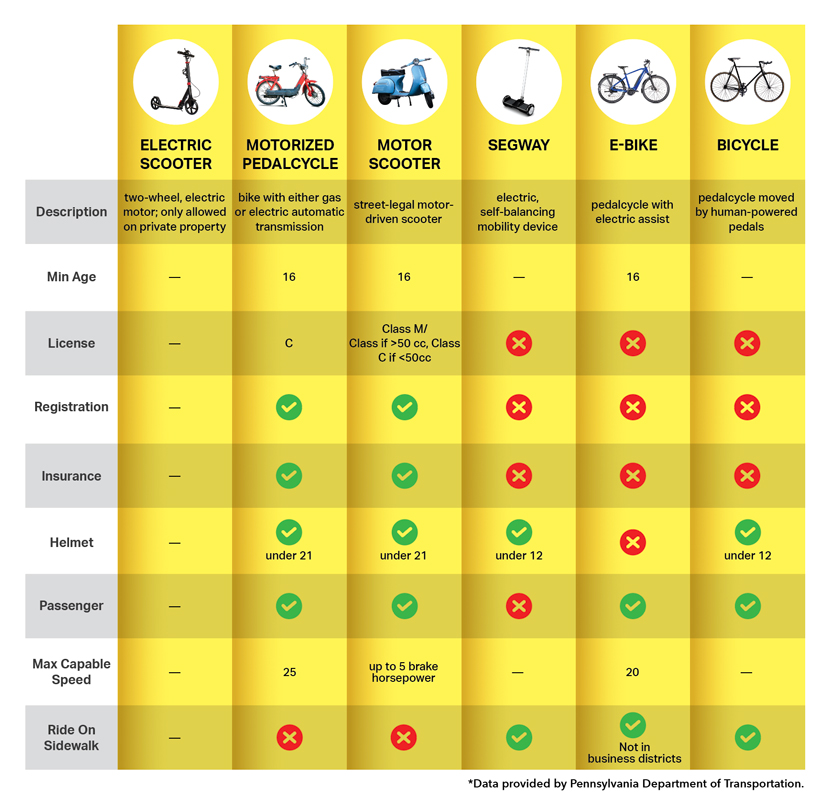
The Pennsylvania vehicle code defines an e-bike as a pedalcycle with electric assist. E-bikes cannot weigh more than 100 pounds, with a motor of no more than 750 watts. You must be at least 16 to use one. Like motorcycles and bicycles, e-bikes are classified as modes of micromobility. Other modes, as defined by the vehicle code, are:
- Motorized pedalcycles have operable pedals, powered by either a gas motor or an electric battery, with speeds of no more than 25 mph. Like motorcycles, motorized pedalcycles require a license, registration and insurance, and operators must be at least 16 years old.
- Segways are electric, self-balancing, two-wheeled devices. Lighting must be used when operating between sunset and sunrise. Segways are allowed on sidewalks in Mt. Lebanon.
- E-scooters, battery-powered scooters, skateboards and unicycles can only be operated on private property.
“Electric scooters cannot be driven on the road or on the sidewalk because they lack the necessary equipment — such as lighting, mirrors and turn signals — for them to be safely operated,” said Cpl. Ty Kegarise of the Mt. Lebanon Police Department.
Does this mean you can be cited for riding your scooter on the streets?
“At this time, there are no existing statutes directly related to enforcement for electric scooters,” said Kegarise. “The statutes that apply to them would also apply to motor vehicles, such as registration requirements and lighting requirements.”
This legal gray area may become clearer as legislation is considered by the Pennsylvania Senate.
(E-scooters are not the same as motorized scooters, like a Vespa. Those can be used on the street, by licensed drivers 16 or older. They are also not the same as the motorized scooters used by people with mobility issues. Those are allowed anywhere in the municipality, even on sidewalks in the business districts, where other wheeled vehicles are prohibited.)
State Sen. Timothy Kearney, from Delaware County, is crafting “Abby’s Law,” named for Abigail Gillon, a 12-year-old girl who died this year after being thrown into traffic from her e-scooter as she and a friend entered the road.
“Now is the time to clear up the legal gray zone in which e-scooters currently sit, and to honor the life of Abby Gillon by ensuring proper safeguards for teen use,” Kearney wrote. The legislation, which at press time had not yet been introduced, could further define electric scooters in the vehicle code and require their users to follow the rules of the road, mandate helmet use for minors and prohibit children under age 16 from operating an electric scooter.
Victor Deneen, a Mellon Middle School student, frequently rides his e-scooter around Mt. Lebanon and the Uptown area since he got the vehicle in February 2025.
“The scooter makes it easier to get around,” said Deneen, adding “this way my parents don’t have to drive me everywhere.”
Deneen noted that e-scootering is pretty common among his friends and kids his age. He’s not too sure of the regulations that come with the e-scooter, but he knows that it makes life easier for his parents and him.
Micromobility infrastructure (or lack thereof)

Margaret Satersmoen, an e-bike rider and a teacher at Foster Elementary, sees room for improvement in Mt. Lebanon’s micromobility infrastructure. Satersmoen bought a pedal-assist e-bike a couple of years ago.
She rides the e-bike two to three times a week, as it’s easier than a car to park and maneuver. She, like Ivey, encounters issues with safety and awareness.
“When I’m riding Uptown, I need to be mindful of other pedestrians, but cars need to be mindful of me as well,” said Satersmoen. When cars pass her on Washington Road, it pushes her dangerously close to the parked cars, that could then open their doors and hurt her or others.
State law requires drivers to leave at least four feet of space between themselves and cyclists while passing.
Satersmoen suggests people use the “Dutch reach” to be more careful. In countries with more substantial bike infrastructure, people are taught to open the car door with the hand that’s farther away from the door, forcing them to look over their shoulder to see possible hazards. Something this simple could prevent a major accident.
“I wish that when people see a bike, they feel kindness and patience because every bike takes one car off the street. This means there’s less traffic congestion and less competition; It’s better for the environment and the community,” said Satersmoen.
“When I ride in the city of Pittsburgh, the infrastructure does help. Whether it’s painting, signage, shared lanes, slow streets or other traffic-slowing methods,” she explained. Satersmoen thinks if Mt. Lebanon employed some of these safety methods, both bikers and drivers may feel better about sharing the road.
Mt. Lebanon has a plan in place. The Complete Streets Policy, adopted by the Commission in 2022, sets goals to improve walkability and rideability. However, the municipality faces challenges installing bike lanes, due to road ownership.
“Most of the major thoroughfares through the community are owned by either the state (Pennsylvania Department of Transportation) or the county,” said Ian McMeans, Mt. Lebanon assistant manager and municipal planner. These include Castle Shannon Boulevard, Washington, Cochran, Connor/Gilkeson and Bower Hill roads.
McMeans looks excitedly toward the Active Transportation Plan, a collaboration between Mt. Lebanon and Dormont announced in May 2025, which will prioritize smaller-scale transportation infrastructure investments.
The future of micromobility
Some residents simply feel safer riding electric.
Both Ivey and Satersmoen report that the e-bike is better with hills and makes them feel safer, given the speed of traffic.
“The lack of infrastructure (racks, bike lanes and general road conditions) does not make me feel comfortable using non-electric micromobility at this time,” said Seth Davis of Hillcrest Place.
Davis, who is on the Mt. Lebanon Mobility Board and the board of Move Lebo, works for Pittsburgh Regional Transit. As an expert in mobility and transportation, Davis is hopeful for the future of micromobility in Mt. Lebanon, both electric and non-electric.
POGOH is a Pittsburgh-based bike share initiative that found success in the city, and Davis believes this shared micromobility may have a future in Mt. Lebanon.
“Paired with the proper infrastructure, I envision a subnetwork of POGOH in the South Hills being extremely successful if stations are strategically placed around the business districts as well as at PRT light rail stations,” he said.
“As Dormont and Mt. Lebanon launch an active transportation planning process, the opportunity is ripe to incorporate supportive elements for micromobility and active transportation devices,” added Davis.
A recent Pennsylvania Supreme Court ruling might make this process a little easier and encourage non-electric bike riders to feel safer on the road.
Pennsylvania law now reads, “a pedalcycle may be operated at a safe and reasonable speed appropriate for the pedalcycle. A pedalcycle operator shall use reasonable efforts so as not to impede the normal and reasonable movement of traffic.”
Cyclists do not have an obligation to get off the road, and cars do not have the right to force them to do so. Affirming the rights of bikes on the road points toward a brighter future for micromobility.
Just as micromobility grows and changes, transportation infrastructure and laws change with it.