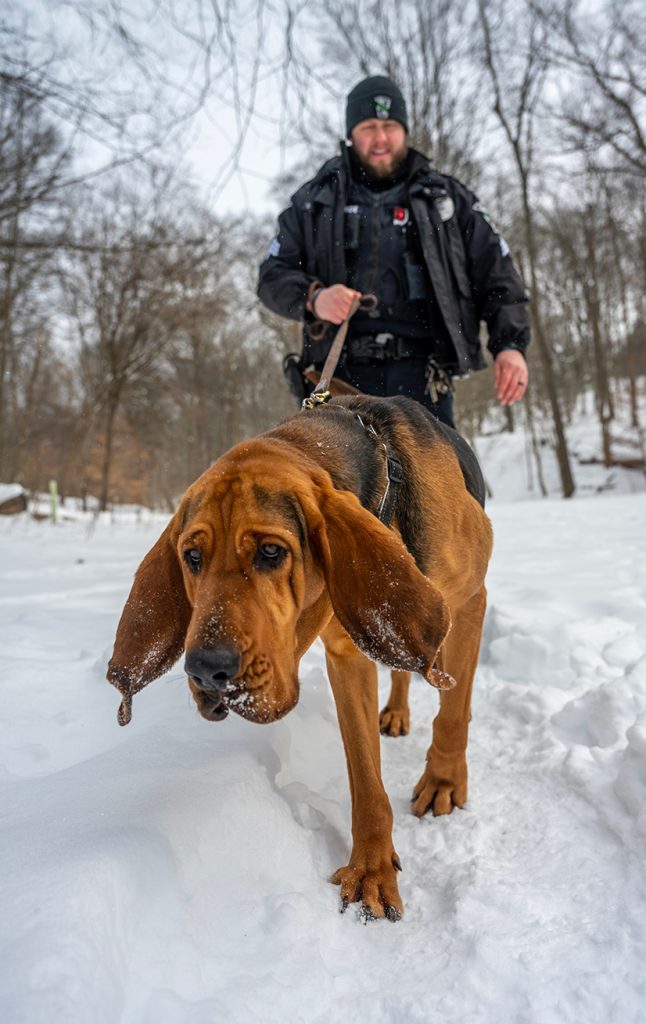
Bloodhounds have 300 million scent receptors — the most of any dog breed and 60 times more than humans. Their power lies in scent discrimination, which is the ability to follow one specific odor among thousands of others. Humans shed roughly 40,000 skin cells every minute, and the odor created by those cells is as unique as a fingerprint.
Bloodhounds, which are uniquely talented in tracking these odors, are the first animal whose evidence was admissible in U.S. courts, and they’re commonly employed by police for their excellent sleuthing skills. The big, muscular, floppy-eared dog known for its signature skin folds was first bred in the Middle Ages by monks and used by hunters to track prey.
With faces low to the ground, bloodhounds’ long ears and loose facial skin stir up scents and trap them close to the nose. The breed is generally calm and deliberate with a keen focus and drive. In order to succeed as police dogs, bloodhounds require comprehensive training, because it can be difficult to redirect their focus once they lock onto a scent.
K-9 Bear of the Mt. Lebanon Police Department exemplifies all the traits of a successful police dog. He’s an additional investigative resource who can help officers locate missing people or fleeing suspects, Sgt. Dan McBride explained. McBride has been Bear’s handler since the four-legged detective joined the department in 2022.
Bloodhound tracking: fact or fiction
Many people assume bloodhounds only search for missing people, that they work best in rural fields and forests, or that if a bloodhound is deployed, the target will always be found. Reality, as McBride explained, is far more nuanced.
Environmental factors including weather, temperature, wind, humidity, time, surface materials and even foot traffic can all affect a trail. Under optimal conditions, Bear can follow a scent trail that is hours, days or even weeks old. And success doesn’t always mean finding a person at the end of the deployment.
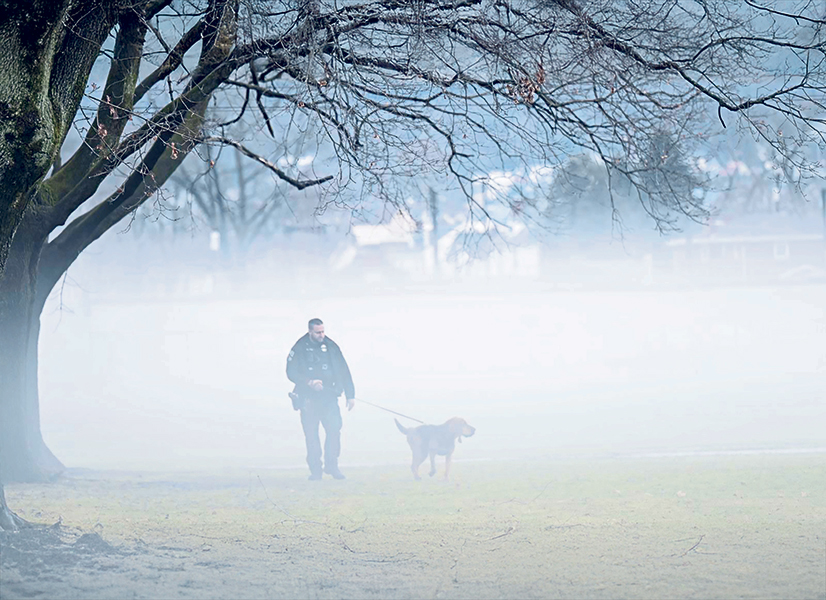
Sometimes Bear provides a “negative alert,” indicating a person was never at a particular location. In other cases, he helps determine travel paths, vehicle pickup points or places where evidence was discarded. Those details can lead investigators to surveillance footage, weapons or answers that might otherwise remained hidden.
Bear responds to 30 to 40 calls a year, though many of the calls resolve before he even arrives. That, McBride says, still counts as a success.
“Ultimately, that’s the goal, whether it’s a suspect, a missing kid or a missing elderly person,” McBride noted. “Whether we find him or other people find him, that’s the ultimate goal.”
Bear is one of four K-9 bloodhounds in Allegheny County and is deployed for a range of cases, from robberies and hit-and-runs to missing children, dementia walkaways, runaway juveniles and mental health crises. Recent deployments include a kidnapping in Clairton, a suicidal woman in Sewickley, a fleeing suspect in Baldwin, dementia patients in Bethel Park and Brentwood, and missing or runaway juveniles in Mt. Lebanon. In each of these cases, Bear either located the individual or gathered information that led to eventual locations.
Some of the most challenging tracks are older ones — 18 to 24 hours after an incident — especially in heavily trafficked areas.
Thousands of people walking over a trail in a congested area like Washington Road adds complexity, McBride said. “The dogs can do that. It just adds another layer of difficulty to it, that’s all.”
One of McBride’s most memorable cases with Bear happened to be the first call he responded to. While tracking a fleeing domestic violence suspect up a steep hillside in Moon Township, Bear indicated the suspect had gone over the edge. Officers later located the man at the bottom of the hill, deceased. While it was a tragic outcome, the deployment was a confirmation that Bear’s instincts and training were sound.
Bloodhounds require meticulous and continuous training to become expert investigators, especially since the breed has a notorious stubborn streak.
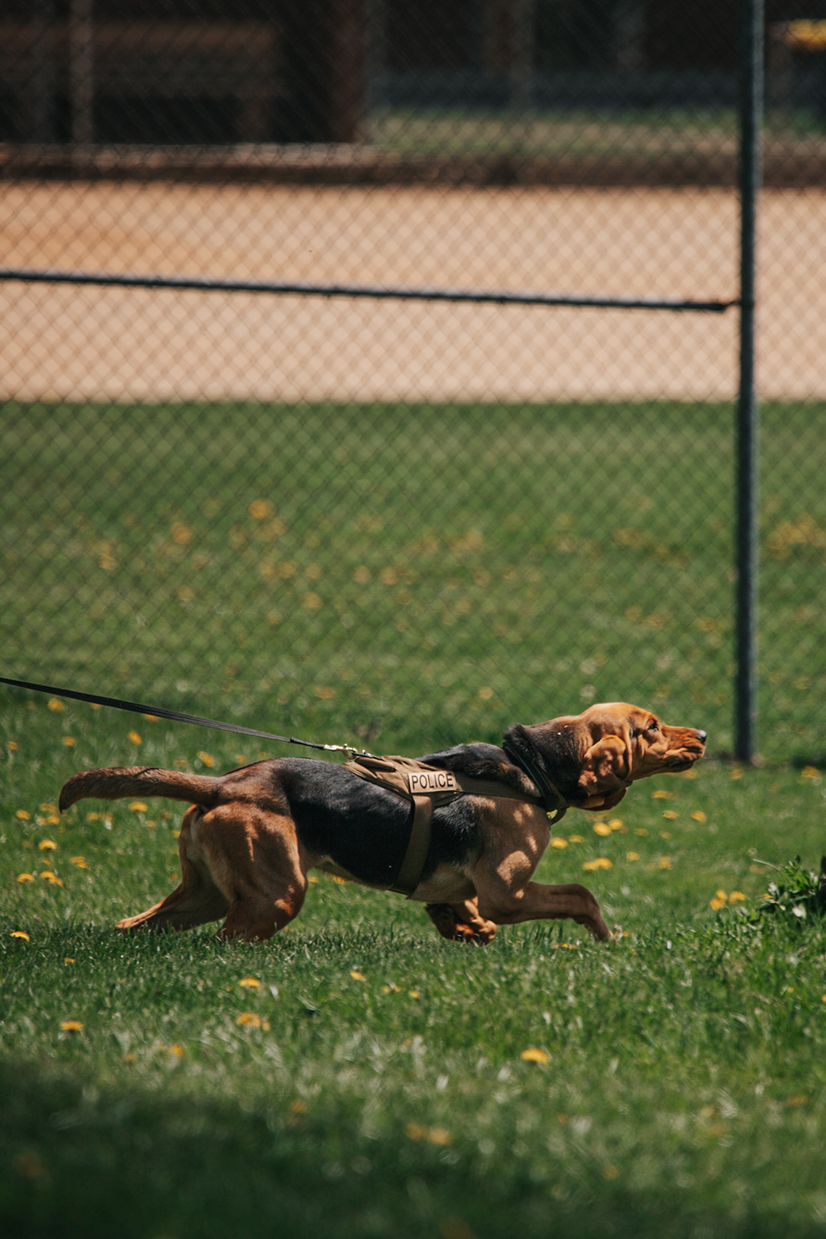
Ongoing training is demanding. Bear and McBride complete a minimum of 16 hours of training each month, logging every track in PackTrack, an online K-9 record-keeping system. The pair attends yearly seminars with handlers from across the country.
“We train in all weather conditions. Sometimes we’re training in the middle of the night and then the snow and the sleet and the rain,” McBride said.
Much of the training focuses on building drive and teaching the dog that finding the target is more rewarding than any distraction. At the end of a successful track, the “trail layer” greets Bear with food and praise, reinforcing that he completed the task at hand. Deer, squirrels, other dogs, busy streets — everything competes with the scent trail, and bloodhounds need to focus to succeed.
Knowing when to stop is just as important as knowing how to track. Bloodhounds will push themselves to exhaustion if allowed, McBride explained, so he watches Bear’s body language closely, especially in summer heat, taking breaks as needed to prevent exhaustion.
MLPD’s first
Bear is Mt. Lebanon’s first bloodhound and part of a program McBride and the department built from the ground up. When the department decided to add a bloodhound unit, officers spent months researching breeders, trainers and training models. Ultimately, they chose a semi–pre-trained dog from Tin Star K-9 in Winnebago, Illinois, where Bear learned from retired law enforcement officers.
“He had a good personality,” McBride said of his confident, social K-9 companion. “We thought with everything that we have going on in our town, with schools and being out in the public, that he would be a good fit.”
Bear was named in honor of Mt. Lebanon Police Ofc. Jerrod Withrow — nicknamed Bear — who died of colon cancer in 2021. His parents, Gail and Randy Withrow, were lead donors for the K-9 program. Much of Bear’s purchase and care, along with his custom-built kennel, was made possible through community donations.
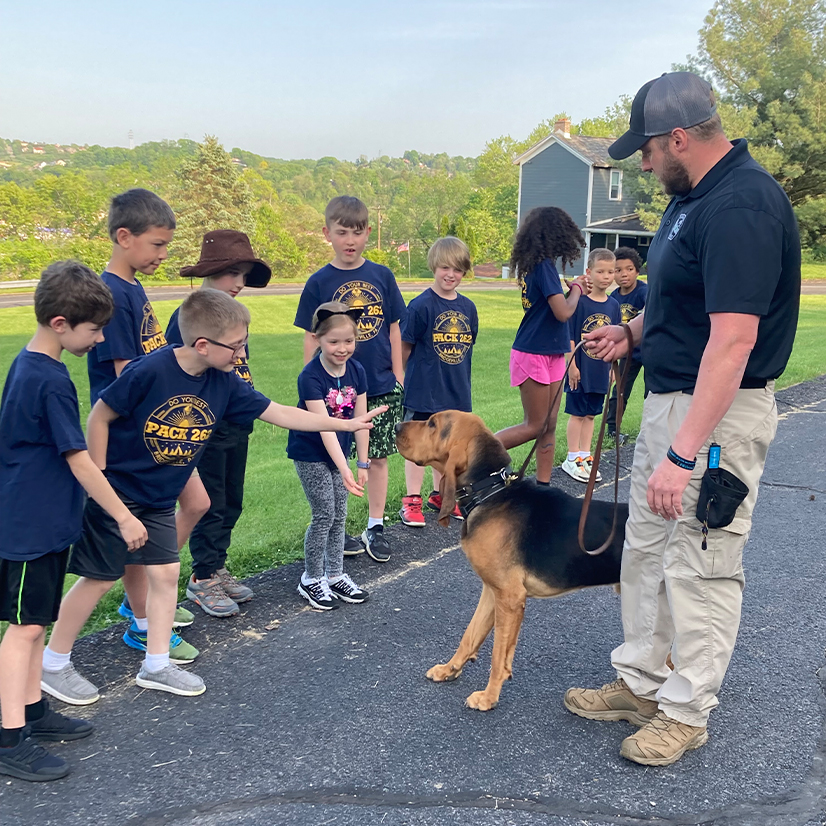
In addition to his tracking duties, Bear is also a strong community outreach resource. He attends block parties, Touch-a-Truck events, school visits, food drives, the recreation department’s public safety camps and meet-and-greets. Kids recognize him instantly.
McBride said Bear’s interactions with kids is one of the best parts of the job. “The impact on the community, I would say, is what sticks out to me.”
Today, at 4 years old, Bear is in the prime of his career. Bloodhounds typically serve until age 8, after which Bear will enjoy a relaxing retirement with McBride at home. Until then, he’ll be travelling Mt. Lebanon and southwestern Pennsylvania, dividing his time between police deployments and community outreach.