
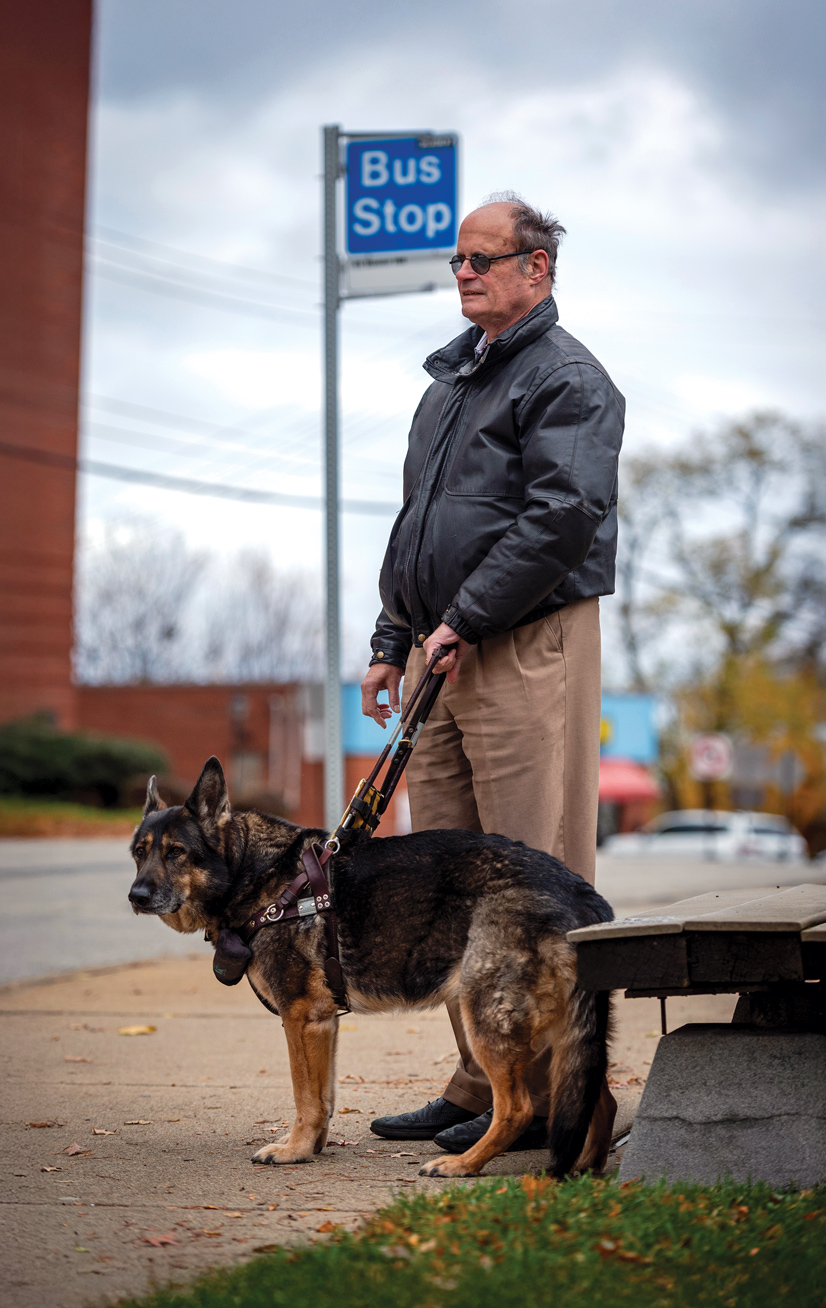
“Usually when I go into town, I use the 41,” said Tom Burgunder, who is visually impaired and lives on Washington Road. “When I come out of town, I sometimes use the T depending on the schedule. I can’t see, so I don’t drive.” Burgunder has relied on Pittsburgh Regional Transit (PRT) for more than five decades — and his dependence on it underscores how vital public transit remains for Mt. Lebanon residents.
Once defined by its iconic trolley lines running along Washington Road, Mt. Lebanon remains a major link in the PRT’s southern network — even as funding challenges, route redesigns and service shifts reshape how people get around.
Over the past year, transit riders in Mt. Lebanon have seen more than their share of ups and downs. Early in 2024, riders faced the looming prospect of major service reductions as PRT braced for a 35 percent cut to operations. Plans to make Mt. Lebanon a transit hub and restore direct Oakland service were shelved amid what officials called a fiscal cliff. But by late summer, those cuts were rolled back after state officials allowed PRT to temporarily shift “capital” funds — money typically used for infrastructure projects — into its operating budget.
That financial pivot stabilized service for now, but it came at a cost. PRT Communications Specialist Eddie Phillipps said the move delays some non-safety infrastructure projects and only guarantees stable operations for the next two years. Without new long-term funding, transit agencies statewide will face similar crises down the road.
Seth Davis, manager of corridor planning for PRT and a Mt. Lebanon resident who serves on the volunteer Mobility Board, said those challenges underscore how deeply local and state budgets shape the daily lives of transit riders.
“These were not cuts the agency wanted to make,” said Davis, a Parker Gardens resident. “To keep any service on the roads, we had to make deep reductions. Now, the capital-to-operating shift has allowed us to stave off longer-term cuts and return to some of the planning we were previously doing.”
That planning includes the next phase. The PRT, led by the planning department, is guiding the creation of the Proposed Network 2.0 effort through the Bus Line Redesign project. It aims to align routes with current travel patterns and population density rather than increase total service hours.
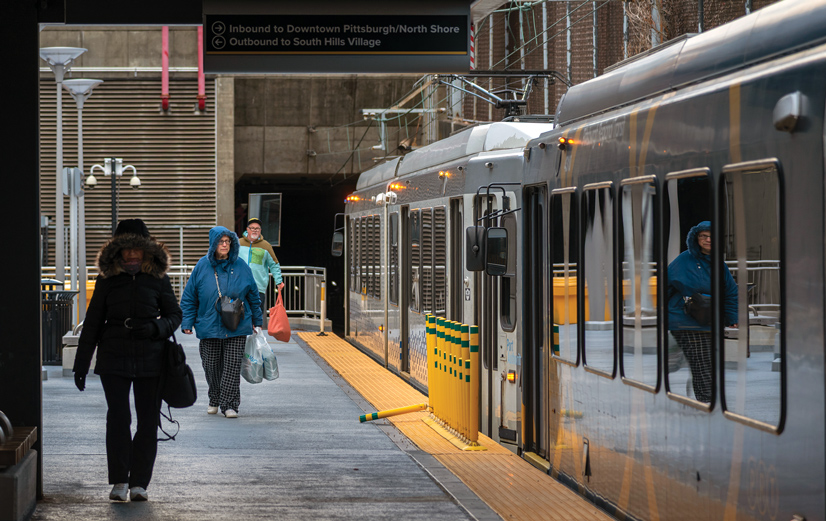
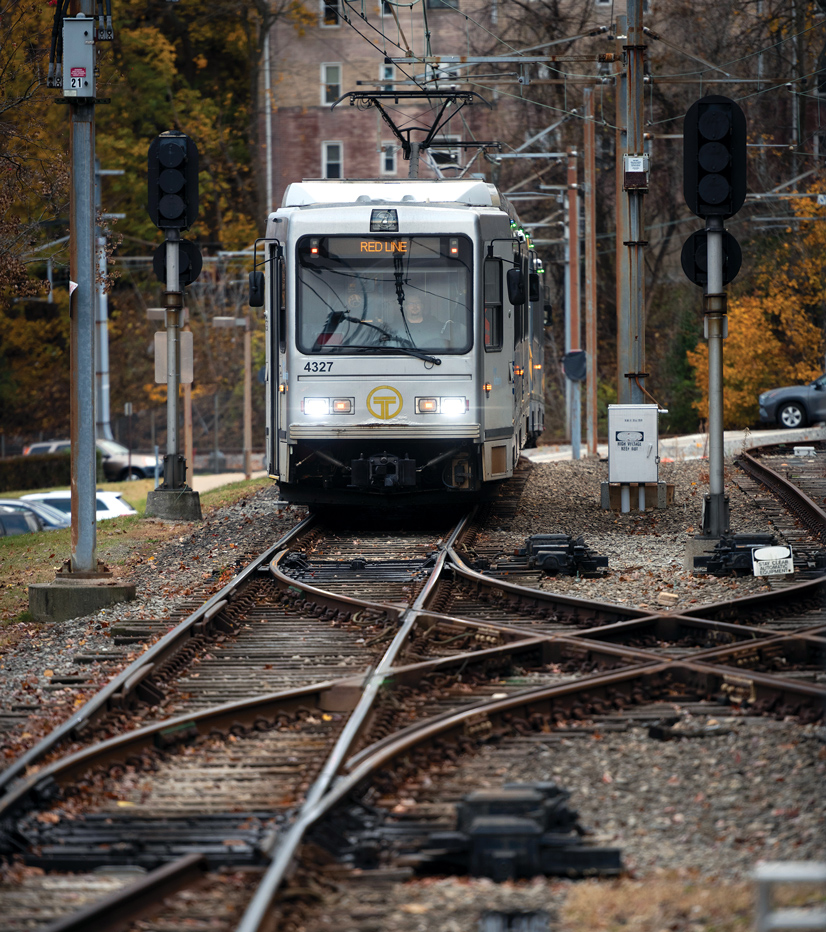
Davis noted that Mt. Lebanon’s role in the regional network remains central. The Red Line light rail continues to anchor local travel with three stations, Mt. Lebanon, Poplar and Arlington, while bus routes 38M, 36 and 41 connect residents to surrounding areas and downtown.
“Mt. Lebanon has always been a critical cog,” Davis said. “It’s what you’d call a classic trolley community. Clearview Common used to be the trolley turnaround. The Red Line is a legacy of that history.”
A Local Perspective
Charlotte Ford, a Washington Park neighborhood resident and member of Mt. Lebanon’s Mobility Board, said she’s been a long-time PRT rider herself, taking the bus downtown for work throughout her career. “It’s personal to me,” Ford said. “Driving is just not feasible with the cost of parking, and that’s true for a lot of Mt. Lebanon residents.”
She added that many residents forget how much daily life depends on accessible transportation. “It’s a necessary utility for people to get to work or to where they need to go — not be isolated,” Ford said. “It’s not just about getting to downtown; it’s about being able to live.”
Burgunder, who serves on both the PRT Board of Directors and the Committee for Accessible Transit, said he wasn’t happy about the prospect of losing service last spring — but he trusted the system would find a way forward.
“Nobody at PRT wanted these service cuts to occur,” he said. “They understood the impact of the potential service cuts on the people who use the services, not just for buses and the T, but also for the ACCESS program. They were sympathetic to that issue and concerned for themselves because those cuts would have meant layoffs inside the agency.”
For Burgunder, the temporary funding solution offers a brief reprieve.
“Right now, we have a two-year window where they’ve shifted money from the capital budget over to operations,” he said. “We know that, all things being equal, things are going to be pretty much the way they are now for two years. Beyond that, I don’t think anybody knows.”
Both Burgunder and former state Rep. Dan Miller, who also lives in Mt. Lebanon, said the stakes are highest for those who have no other transportation options.
“What keeps me up at night are the people who need it because they have no personal vehicle,” Miller said. “For many, life cannot function without an accessible, affordable, complete build-out of a public transit system.”
Miller, who chose to live in Mt. Lebanon partly because of its access to the T, said he views transit as a “lifeline” for people who depend on it to reach work, appointments and essential services. He added that the accessibility aspect of public transit often goes unnoticed.
“Too often people forget the accessibility aspects that come along with PRT,” he said. “When we’re talking about access to life, we’re talking about access to life for everybody.”
Burgunder, who has long advocated for riders with disabilities, echoed that concern. Through the Committee for Accessible Transit, he said representatives meet with PRT leadership before public announcements to discuss potential impacts on riders with disabilities. Those meetings, he said, help ensure accessibility remains part of systemwide planning.
“We meet with PRT officials and talk about the proposed changes and how they’re going to impact that population,” he said. “In the case of this past spring, people in that constituency were encouraged to testify during public hearings about how cuts would affect their daily lives — getting to work, getting to dialysis, general trips. There was a lot of give and take, and PRT took those comments into consideration.”
After 55 years as a transit rider, Burgunder hopes for a more stable and equitable future.
“I hope they’re able to attract a consistent funding source so they can plan years ahead,” he said. “If that happens, I hope they’ll look at where people are actually going — maybe more service from the South Hills to Oakland, for example, instead of just to downtown.”
Miller said that perspective reflects what’s often overlooked in discussions about funding and operations.
“We want the system to be there for those fun trips into the city — to a ballgame or a concert — but we can’t lose sight of the fact that for so many people, life cannot function without an accessible, affordable public transit system.”
The concerns voiced by Burgunder and Miller reflect a broader community sentiment: that reliable public transit isn’t just about convenience — it’s about access to opportunity and independence for everyone.
Behind the Congestion
Even with that legacy, modern challenges persist. Davis, who regularly commutes via the 36 and 41, says reliability often suffers due to traffic along corridors like Banksville Road.
“The 36 is scheduled to be downtown at 8:35, but it regularly gets there closer to 8:45,” he said. “That’s all congestion. When a bus isn’t on time, it has reliability impacts down the line.”
To address these issues, Mt. Lebanon and neighboring Dormont are working with PRT on a joint Active Transportation Plan designed to improve pedestrian access to stops and reduce dependence on cars. Davis called the effort “a critical step” toward improving first- and last-mile connections.
The Budget Question
Like many public transit systems nationwide, PRT’s funding model remains fragile. About half of its operating budget comes from the state, supplemented by federal, county and farebox revenue. When Pennsylvania’s Act 89, passed in 2013 to fund transportation, expired in 2021, PRT lost a key revenue source.
“There hasn’t been a new law passed to continue those operating funds,” Davis explained. “Several bills have been put forward, but none have moved.”
Miller said that while short-term relief measures kept buses and trains running, the larger problem remains imminent.
“The problem really isn’t long term,” Miller said. “The problem is right around the bend. We weren’t trying to punt the problem off to some faraway future — we were trying to avoid a bigger train wreck in two to three years.”
Miller said the temporary budget fix “was good” in that it prevented immediate cuts but warned it could create a “larger problem that will impact even more people in about two or three years.”
He added that the state must be a reliable funding partner for counties like Allegheny to make transit systems sustainable.
“The answer is that the state has to be that partner,” Miller said. “We’ve done it before. In 2013, Democrats and Republicans, labor and business came together on a compromise to fund transportation. The state has an obligation to support systems we depend on for life and economic issues. We need a sustainable, common-sense approach that recognizes how essential transit is — not just for today’s needs but for tomorrow’s growth.”
Pennsylvania’s state budget, passed in November 2025, contains no increased funding for public transportation.
What’s Next
In addition to the Proposed Network 2.0, Davis’ team is preparing to launch a Rail System Optimization Plan that will assess how the light-rail system can be strengthened amid declining ridership since the pandemic. He said the effort will involve municipalities across the South Hills, including Mt. Lebanon.
Meanwhile, the community can expect ongoing public engagement opportunities as PRT reopens the conversation about route design and investment priorities.
“We’re willing partners,” Davis said. “We know our municipal partners are critical to delivering good service. If residents haven’t tried transit since before the pandemic, I’d encourage them to give it another shot. It’s a great way to just zone out, listen to music, or read a book — and you’re letting a professional driver do the work.”
Need to Contact the PRT?
Residents can reach PRT’s customer service by calling 412-442-2000 or using the online chat feature available on the PRT website, rideprt.org [1].