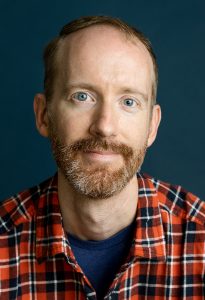
Nate Powell, the first cartoonist to receive a National Book Award, has a strong visual memory and remembers the day he lost his childhood innocence.
In northeastern Alabama, during the early 1980s, he and his parents drove through a village outside of Anniston. On a large public lawn, Ku Klux Klan members, dressed in white sheets and hoods, were standing in a circle around a 12-foot-high cross with their arms raised.
Though Powell was 5 years old, “I knew instinctively that this was something evil and villainous …. I felt the menace and I felt the danger,” he said during a telephone interview from his home in Bloomington, Indiana.
The author of more than 20 books, Powell speaks on Monday, Sept. 29, at 7 p.m, in Room A on the ground floor of the Mt. Lebanon Public Library. Patrons are asked to register for the event [1].
His parents, Powell said, “explained in very plain language who the Klan was and that they were a dangerous group of violent racists.” His parents also said the KKK “represented a different time” from the Deep South’s past.
Powell disagreed.
“Not only was I seeing the present … it literally was not a different time,” he recalled. “My parents and a lot of southern white boomers … needed to immediately move on from the continuity of growing up in the segregated south.”
Much of Powell’s work confronts America’s turbulent history, especially March, a trilogy about John Lewis, the late U.S. Congressman and civil rights activist. Powell illustrated March, and Lewis and Andrew Aydin wrote it.
Reading X-Men comics at age 12 helped Powell develop a social conscience.
“X-Men was a lens through which to understand racism, homophobia and sexism,” he said. “It was incredibly transformative and allowed me to see what my world of 1990s Arkansas was like. You need to stand for certain things and you need to stand against certain things. It’s not enough to sit on the fence. We have a duty to look out for one another.”
Powell’s creativity was stoked while growing up in Little Rock, where he befriended teenagers who drew comic books and zines, played punk rock music, skateboarded and broadcast a Friday night punk music show on the radio.
Powell started his own punk rock band, which began touring in 1997 and played at the Mr. Roboto Project, a volunteer-run show space and art gallery in Pittsburgh’s East End. He played with underground punk bands Soophie Nun Squad and Universe.
“A lot of these formative relationships with these weird young people have survived 30 years,” Powell said, adding that he met Eric Meisberger, a Mt. Lebanon librarian, when both of them played punk rock.
Literary publications and public librarians began taking modern graphic novels seriously, Powell said, after Will Eisner’s book, A Contract With God and Other Tenement Stories, appeared in 1978.
Next, in the late 1980s, Watchmen, the story of a group of superheroes who fall from grace, was published by Alan Moore and Dave Gibbons.
In the second half of the 1990s, Barnes & Noble and Books-A-Million began stocking English language manga, which Powell said, “resulted in an explosion of readership for comics.”
One of Powell’s college classmates, Raina Telgemeier, was influenced by manga and published Smile in 2010. The autobiographical graphic novel recounted Telgemeier’s struggles to fit in with peers from grade six through high school.
After Smile appeared, Powell said, publishers improved distribution of graphic novels, making them more available to schools and public libraries.
“Our work on March coincided with this industry shift and focus to make room for libraries, communities and schools to have access to graphic novels as literature.”