Most adolescents look forward to their 16th birthday. It’s the start of so much: driving, the “real” teenage years, and if you’re lucky enough, maybe even a Sweet Sixteen celebration. Yet, in my household, the best birthday of our teenage years was 15: the year when you could finally become a lifeguard.
My sisters and I grew up hearing stories about the summers my mother spent as a lifeguard and how they were some of the best days of her life. Many of her closest friendships and most devious endeavors developed on and off the pool deck during the summer with her gaggle of coworkers.
A job like lifeguarding for my mother’s generation provided some much-needed structure for her fellow latch-key kids. Unsupervised teens with way too much time on their hands translated surprisingly well into a set of diligent pool-watchers. For me, my 15th birthday was quite the opposite release. At the height of COVID-19, I could not escape my house soon enough. I was willing to work unpaid and overtime if I could spend some time away from my cave called home.

As a member of the Mt. Lebanon Aqua Club for many years of my childhood, it was a natural transition. The older swimmers I admired became lifeguards at the outdoor pool, and I knew I wanted to be just like them. Besides, if you’ve already committed your mornings to practice, why not extend your stay while getting paid to tan? (Obviously, the job is much more serious than that — you complete thorough training and focus while on duty — but I just happened to get some sun while doing so!) Although Mt. Lebanon’s pool was closed during my first eligible summer because of the pandemic, I could secure a job nearby at Scott Township while I waited.

I don’t want to mislead the readers by overly glamorizing the job. If you’re thinking about becoming a lifeguard, it is all but certain that you will encounter a few unpleasantries. You will clean vomit, fecal matter and other unknown bodily substances from the water, pool deck and locker rooms. Almost every summer I worked, I’ve had at least one minor save. I even got one life-threatening save under my belt. Walkie-talkies, although hilariously fun, are a “privilege, not a toy” — something I struggled to remember even as the oldest staff member last summer. Patrons can be rude and leave their garbage for the lifeguards to clean. Parents often assume “lifeguard” is synonymous with “babysitter.” A stormy day lets the lifeguards play, but only until that one family of regulars decides to wait it out, and your boss insists that all chairs remain full. In the grand scheme of things, most of these are trivial concerns. Just be warned, like anything, lifeguarding is a test of patience, teamwork and communication.
As summer wears on, the boundaries lessen, and your co-workers turn into friends, then family. You’ll find yourself begging for shifts not to end so you can soak up even more time with them. August becomes a month to dread, as your blessed pool is about to close for the school year.

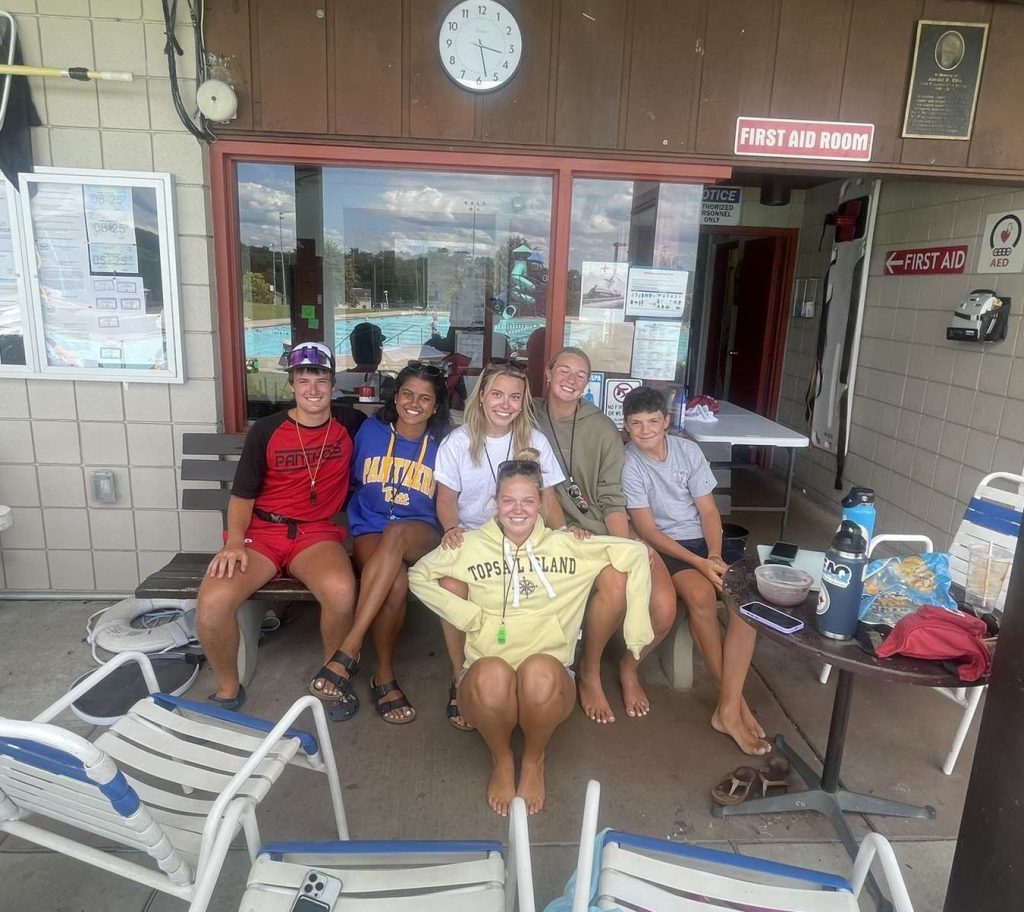
This sounds painfully dramatic, and I am aware of this fact, but I genuinely bawled my eyes out saying goodbye to my longest-held career at the end of last summer, where I ended my lifeguard tenure at the Mt. Lebanon Swim Center [1]. I am still struggling with the idea that I will never be paid to test pool chemicals, chit-chat with my friends, and people-watch with a side of ensuring pool safety ever again. I was a lifeguard for five whole years. Those pools watched me endure some of the greatest eras of change in my life. Leaving lifeguarding was less about facing the inevitable 9-to-5 of this summer and more about mourning my youth. There is something so special about working at a swimming pool, with its lively vibe that you must experience to understand.
During my freshman and sophomore years of college, I picked up lifeguarding shifts at an indoor facility over winter break. I remember being surprised by the number of retirees being trained as lifeguards for part-time jobs. Let’s just say I can see the future … and it’s bright!