



Within Range
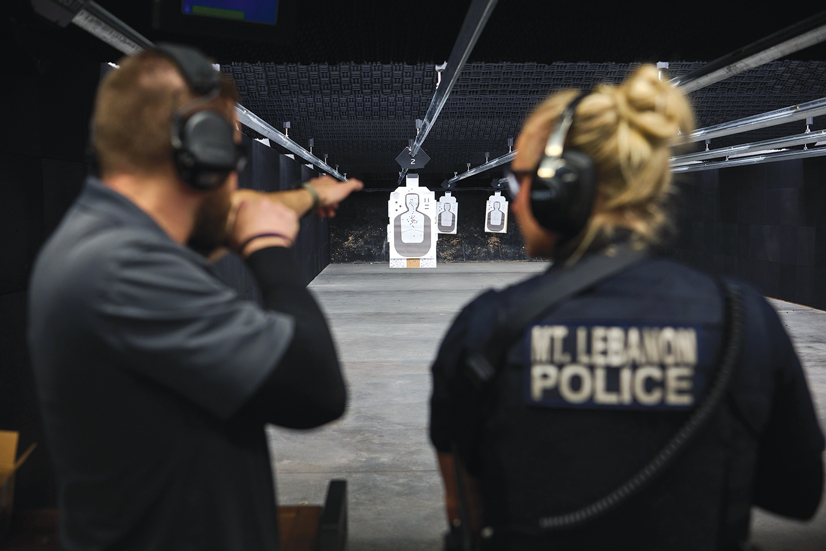
Photo: Nate Yonamine
Try to solve this logistics problem: You have 46 police officers who need to qualify with their firearms once a year, you have three shooting ranges that can give you one or two (maybe three) days a year and you have 100-plus other police departments asking for the same thing. Also, travel time turns an eight-hour training day into maybe six hours of range time.
What’s the answer? Don’t go to the range. Let the range come to you. The Mt. Lebanon Police Department started 2025 with its own firing range, located at the public works facility on Lindendale Drive, next to the fire department’s training facility.
“This allows the officers to become much more proficient and much more effective in their shooting,” said police chief Jason Haberman.
The state requires police officers to qualify annually with firearms. In addition to the state minimum, Mt. Lebanon requires its officers to qualify in several other areas, such as low-light, tactical shooting and a few scenario-based situations. Each police vehicle is equipped with a rifle, so officers need to qualify on that, as well as the department’s collection of less than lethal weapons: tasers, pepper ball rounds and a 40 millimeter foam-round grenade launcher.
Previously, officers would need to travel to ranges in Elizabeth, North Fayette or the county police academy in North Park, just to meet the state minimum requirement. This presented a big challenge in scheduling the time and navigating the needs of other departments.
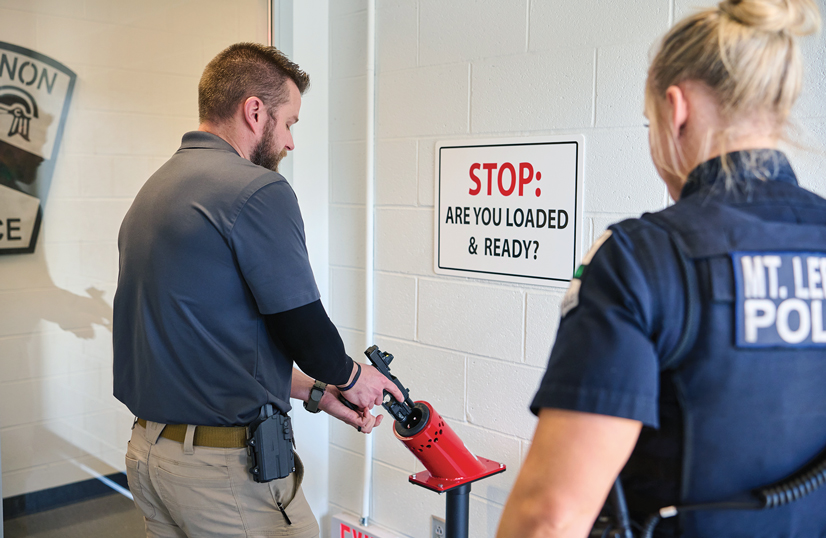
“It wasn’t always a good fit,” said Haberman. “Our training days are scheduled monthly and they allow for us to really have the level of training and preparedness that we need, but when it comes to the range, we also had to fit the range time into our training days. The range allows us to more effectively increase our officers’ capabilities.”
Since the department moved into the space last December, Cpl. Sam Smolarek, MLPD’s rangemaster, and the department’s five firearms instructors have been working on policies and safety protocols. New hires completed their initial qualification, and officers can now easily build range time into their schedules.
One of Smolarek’s rangemaster duties is coordinating the annual qualification shoots for everyone in the department. Having a firing range in town makes that task infinitely easier.
“In Allegheny County, police firing ranges are in short supply,” he said. “You can’t just put one in a corn field somewhere. Having a facility like this really frees us up to get everyone down here, trained and qualified.”
With limited range time, officers could do little more than line up, wait their turn and fire at a target.
“In years past, we had designated training days and it was ‘we have to get our qualifications, no matter what else we do today, this has to get done,’ and it took time.”
That left little time to go beyond the absolute minimum and try to improve officers’ shooting.
“Now, we can identify weaknesses, or things that we want to work on, and we can advance our skills and see some improvement.”
Another plus: the Mt. Lebanon range, unlike the others available, is indoors.
“The police academies graduate in December, so that’s when we get new people,” Smolarek said. “We start their training in January, we’ll be outside for a couple hours and tell them to go warm up in their cars for five or 10 minutes. Of course, we always have to work in the elements, but it’s nice to have the training inside, where rain or shine doesn’t affect us.”
The range has a dedicated space for cleaning weapons; quite a step up from the corner in the basement of the public safety building.
“It’s a really nice benefit to have a good place to lay everything out, so you can do a good job of keeping your equipment clean,” said Smolarek.
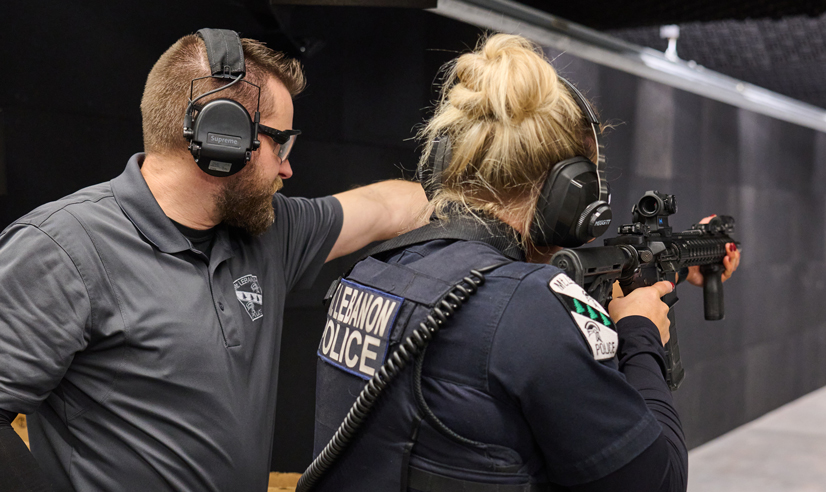
The range itself consists of six 25-yard firing lanes. Targets can be situated at any point in the 25-yard lane, and can also be flipped from front-facing, representing a “threat” to back-facing, representing
“no threat.”
“Outside of private ranges, this type of targeting system doesn’t exist,” said Smolarek. “There’s just a backstop that you staple a target to, and that’s it. We can do a lot of thinking drills here, more than just putting holes in paper. It promotes decision making.”
Smolarek is looking forward to exploring all the possibilities the range has to offer.
“A lot of these things are really cool — I’ve never had the chance to train on something like this, because they just don’t exist in other police ranges.”
Adjustable lighting allows for a wide range of situations, from bright lights to full dark, to nothing but flashing red and blue lights.
“Statistically, most of the incidents happen at night,” said Smolarek. “We used to pull a police car onto the range and put the lights on, but you would never get that really good distraction of the police lights. It’s another one of the things we’ve never seen before outside of very, very high-end places that we just don’t have around here.”
Smolarek credits the department’s leadership with shepherding the range project to completion.
“At Mt. Lebanon, we’re very lucky that we have progressive chiefs and a very supportive administration that pushes us to be better, and to exceed expectations,” he said.
“One of the things the chief has talked about was creating a tactical operations group, not just firearms, but any of the disciplines that we use, our less than lethal platforms, our defensive tactics, our driving, any of that stuff, putting it all together in a group and just staying organized.”
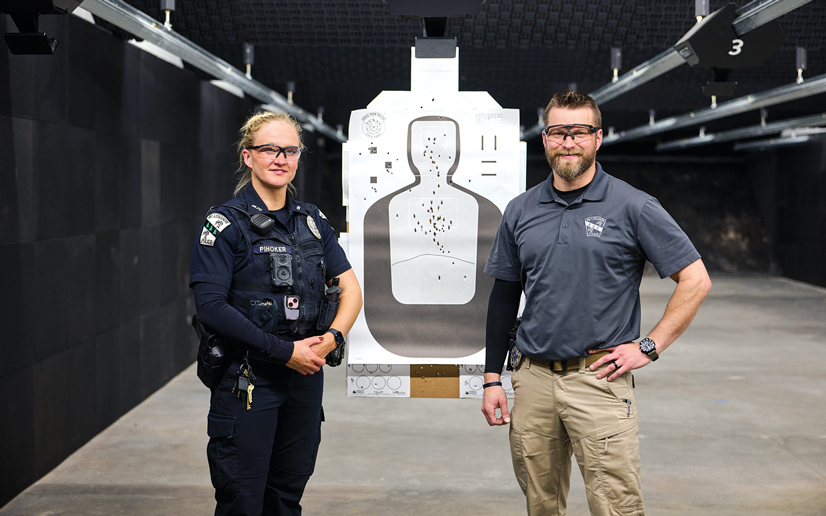
Photo: Nate Yonamine
Haberman, in turn, is pleased with the team effort that made the range possible, a move that, in addition to improving the quality of marksmanship in the department, may also be able to help ease the chronic shortage of range time in Allegheny County.
“You can’t invest the money we’ve invested without investing in the human capital,” he said. “Our information technology department has implemented a lot of the back-end stuff that we needed to do, such as cameras, computer infrastructure and emergency call buttons,” he said. “And I have to give thanks to the manager and the Commission for building such a facility for us to train in. It really will be an asset that we can eventually offer to our partners in the region.”

 Full Story