


Blast from the past
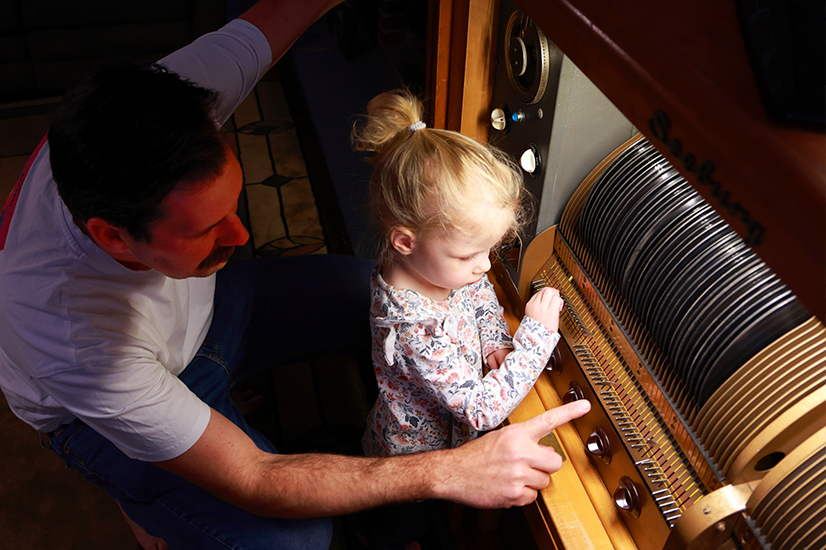
To a toddler like Olivine Toth, it’s pretty much a big toy in the basement.
Generally, dad Phil and mom Kate gently dissuade her from touching the gadgets and gizmos on the credenza-sized contraption at their Altadena Drive home.
But on occasion, she’s allowed to flick a switch and watch the flat disc stored in a slot above it slide backward, eventually followed by the dulcet tones, albeit with some clicks and pops, of a song from at least three-quarters of a century before she was born.
The object of the youngster’s fascination is a 1948 Seeburg 78 RPM Select-O-Matic 200 Home Library Unit, a non-coin-operated jukebox from one of the industry’s top manufacturers. Before the advent of hi-fidelity stereo systems, it represented the state of the art in residential entertainment.
“Sinatra owned one in the day,” Stephen Simeone, a Select-O-Matic enthusiast and Olivine’s great-uncle, will tell you. “They cost as much as a car.”
Yes, the premium model listed for $1,610, a price above, say, a new ’48 Nash 600 or Studebaker Champion.
What the home library unit offers is the ability to store 100 records and play both sides of each – 200 songs, some 14½ hours total – at 78 revolutions per minute. Of course, with the introduction of 33⅓- and 45-rpm discs, the long-standard 78s would become obsolete by the end of the 1950s.
That didn’t dissuade the late Ron Toth of Los Angeles from collecting them, as son Phil learned while cleaning Ron’s San Fernando Valley residence after his passing.
“In the back nether regions of his garage were these old cardboard boxes with dusty old records,” Phil recalled. “There are, what, thousands of records? And they were just stacked on top of each other, no sleeves or anything.”
Their existence was news to the younger Toth.
“I had never heard them,” he said. “My whole life, I didn’t even know they were there, let alone be able to play them.”
Fast-forward a few years, and he, Kate and Olivine live in a freshly renovated house near Bird Park, close to members of Kate’s family but far removed from the longtime southern California home of Phil, a professional sailor with many years of international Olympic class competition.
Kate soon introduced him to Simeone, her uncle and a fellow Mt. Lebanon resident.
“When Phil moved here and he didn’t really know anybody, I was like, these two are just going to click,” she said.
Not only has her prediction come true, but through Uncle Stephen, Phil found a way to give his father’s 78s a listen.
Simeone has his basement set up as what he calls the Suburban Room, “sort of like a speakeasy,” complete with a bar dating back to 1906 and named for a former tavern in his native Dormont. Down there, he has a pair of functioning 1948 Select-O-Matic 200s, among the five he’s restored over the years.
His niece recalls a serendipitous occurrence when she and Phil made an early Suburban Room visit with a container full of 78s in tow: “We break open the box, pull out the first record, and the first record is titled ‘I Wish I Could Shimmie Like My Sister Kate,’” as performed by a group called the California Ramblers. “We popped a bunch of them in, listened to them, and it was just an absolutely lovely evening.”
It was so lovely that Phil asked Uncle Stephen, “So, where do I get one of these?”
“I’m feeling instantly guilty because I have two,” Simeone recalled. “I could give him one, but I’ve been working on these things for 10 years to bring them back to life.”
His solution: a successful online bid for a 1948 Seeburg 78 RPM Select-O-Matic 200 Home Library Unit, delivered to the Toth house without Kate’s prior knowledge.
“I’m in my home office on a call,” she said, “and Phil pretty much hopped into the office and was like, ‘So, there’s a thing coming today.’”
His defense: “Well, it was a gift. Uncle Stephen got it. I didn’t get it.”
When the “thing” arrived, Phil recalls, “We pushed it into the garage and plugged it in. And it spun up and started whirring. The motor ran. Then all of a sudden, pop. And it was DOA. I said, ‘It couldn’t be that easy. I feel like you have to earn it.’”
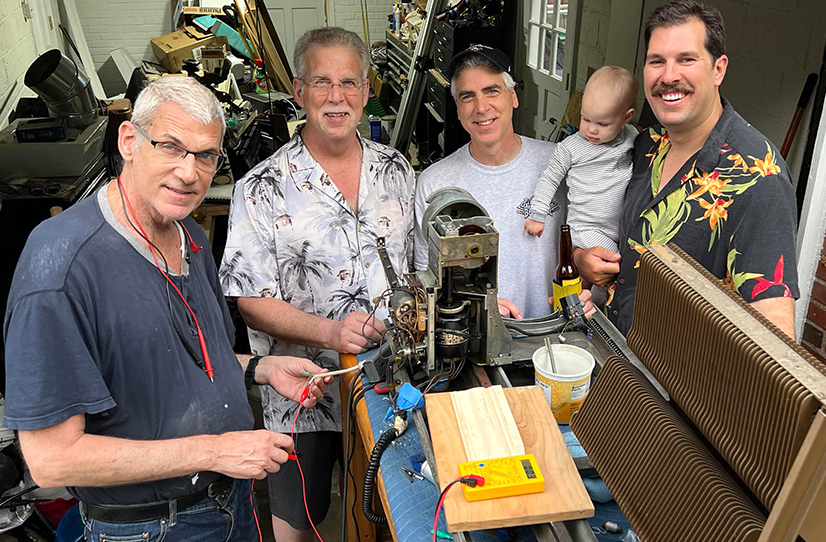
Over the next year or so, he and Stephen – other Simeones helped, too – earned it by working on the jukebox. They diagnosed the initial problem as a blown fuse in the specialized motor, which spins records in two different directions to accommodate the “A” and “B” sides.
The Seeburg now functions as it would have circa 1948, pulling selected discs toward the back and playing them through a now-rare sapphire needle, 18-watt amplifier with connective wires and vacuum tubes eminently visible, and Jensen speaker housed in the bottom of the unit.
All young Olivine Toth knows today is that everything looks intriguing and sounds delightful. But soon enough, she’ll learn her parents have provided her with the gift of knowing music as more than digitally generated background noise.
It may be a toy, even to the adults in the room. But the Select-O-Matic can serve as quite the history lesson, too.
For more information, visit seeburg1948.com.

 Full Story