Catching lizards in Spain

Spending the early part of your childhood in Spain can have a profound impact on a young boy. For Dr. Steven Orebaugh, Flintridge Drive, the experience led him to discover a passion for biology, overcome extreme shyness and gain the inspiration to become a doctor — all thanks to the local lizard population.
His life as a 10-year-old, when his family lived just outside of the military base in Torrejon, Spain, is detailed in a new memoir, The Six-Lined Racerunner, available on Amazon.
“This was a transformative year in my life. I was a painfully shy boy and moving around in the Air Force did not help,” he said.
To this day, he still describes himself as a wallflower.
The son of an Air Force senior master sergeant, Orebaugh was born in Japan and moved every few years. Four of those years were spent in Spain. where he and his friends became enthralled with catching lizards.
“They’re everywhere over there and they’re just fun little creatures to catch — more of a catch and release thing,” he said.
His search for the elusive six-lined race runner — a rare type of lizard found in Spain — lasted a few years. “I only saw two of them the whole time I was over there,” he said. When he finally caught one, it became “the most important lizard ever,” and a real turning point in his life.
Over time, Orebaugh became more and more interested in the biology of lizards and developed an interest in human anatomy after glancing through encyclopedias his father purchased. “That’s the genesis of when I began to think about becoming a doctor,” he said.
Orebaugh, a professor of anesthesiology, has been with the University of Pittsburgh Medical Center for almost 33 years and also worked as an emergency physician.
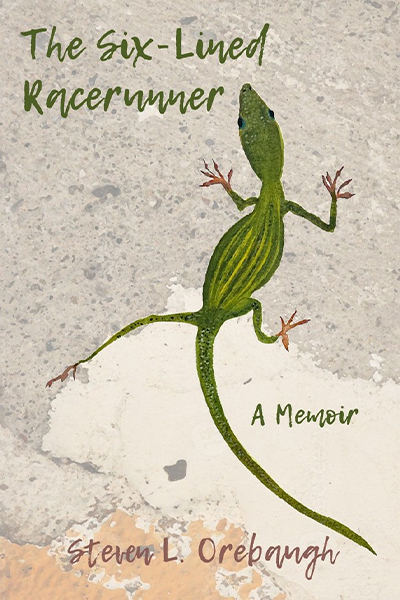
The Six-Lined Racerunner is dedicated to U.S. military families the world over, whose support makes overseas deployments possible. Although it isn’t mentioned in the book, Dr. Orebaugh is a veteran himself, having served in the Navy medical corps, where he achieved the rank of captain.
“I don’t think there’s a lot of literature out there that celebrates or chronicles what it’s like to be a military family and support people that are overseas and how that can be at once very, very enjoyable and a great opportunity, but also be quite challenging, changing schools frequently, going to a foreign country, not speaking the language, being a little reluctant to go outside your normal parameters,” he pointed out.
In addition to offering a snapshot of military life, the book provides a mini travelogue of Spain and Orebaugh’s exposure to the culture and the language and a snapshot of his fateful year as a fifth grader when things really started to click.
That’s when his father encouraged him to play baseball. “And I had a great fifth-grade teacher, who was one of those teachers you remember for the rest of your life, because they set you on a course,” Orebaugh recounted.
“All these things came together in kind of a magical way for me that year and helped push me out of my shell and become a little bit more successful as I moved through the years,” he pointed out.
Orebaugh hopes his story will help inspire others who may feel marginalized.
“Also, people who like lizards,” he quipped.

 Full Story