



Closing ranks on cancer
Bridgette Daugherty, a bright-eyed 35-year-old Mt. Lebanon volunteer firefighter, scheduled her fire department-provided annual physical a week early last November because she was going on vacation abroad and wanted to get it out of the way.
That bloodwork.
Elevated liver enzymes immediately concerned Dr. Chris Maropis, the medical director of St. Clair Occupational Medicine. A windstorm of X-rays, exams and additional bloodwork followed. On January 3, Daugherty was admitted to UPMC Shadyside, had a biopsy at 8 a.m. and her first round of chemo for stage IV breast cancer by 4 p.m. Although she felt fine weeks before, she was now exhausted, and in organ failure.
To knock down a fire, firefighters must ventilate the structure, that is, get rid of heat and smoke so they can attack the flames. To ventilate, some firefighting education materials suggest they practice the “Three Cs of Ventilation” — Communication, Coordination and Control. The Mt. Lebanon Fire Department internally communicated Daugherty’s situation immediately by forming Bridgette’s Fire Brigade and coordinating help. QR codes were posted around the station for firefighters to sign up for tasks, starting during winter with snow shoveling and firewood stacking. They showed up in casual firefighter garb during her week in the hospital, with blankets, socks and milkshakes, attracting positive attention from the staff and making people smile.
They brought her helmet to her home and presented her new badge when she completed her first year of service. They drive her to some of her 7 a.m. chemo treatments. They walk Sherlock, her husky/pittie pup. They let her know they’re thinking of her by “buzzing the tower” (a nod to fighter pilots who fly low and close to the control tower) by driving past her Rockwood Drive home and honking.
Daugherty is overwhelmed with gratitude. “It was unbelievable,” she said of their immediate response. “They just do it. That’s a firefighter for you.”
Maropis would not take credit for catching her cancer, instead pointing to Mt. Lebanon’s rigorous firefighter health testing, calling it “the gold standard of fire departments.”
The department, which has 16 career and 46 volunteer firefighters, has an active peer support group, assembled about three years ago by former firefighter Loren Hughes. Today’s six-member team, led by Deputy Chief Michael Stohner, assists in many situations, including family issues, family deaths and even interpersonal conflicts. Resources include Peg Kearney, a social worker who helped first responders after 9-11 and after the U.S. Air Flight 427 crash in Hopewell in 1994.
The team helps members deal with consequences of repeated exposure to traumatic events. “It doesn’t take long working in any of the first responder fields to see things that are hard to work through or forget,” Stohner said.
“I’ve never been in an internal fire,” Daugherty said, “but I’ve pumped a chest a few times [during CPR] and I needed support after that.”

“There has been a long tradition of brother and sisterhood in the fire service,” Stohner said. “The peer support team just formalizes some of the best aspects of this and makes sure that people don’t fall through the cracks when they need that help the most.”
But the existence of the team is not the only reason the Mt. Lebanon Fire Department is helping Daugherty. Colleagues say she deserves it because of how she truly cares about people, setting the example for engaging them every chance she gets. “By doing this, you brought change and impact to the culture of our department and I can assure you that is the single hardest thing anyone can do in the fire service,” Mt. Lebanon Fire Lt. Josh Sadowy wrote in a handwritten letter. “No certification or firefight will ever be more challenging than that. You promoted everyone to communicate on a personal level and for that I think you should be unapologetically proud. … There is a whole department of your peers who are here for you and are thinking about you.”
Newly appointed Fire Chief Kurt Christofel says Daugherty is approachable and good natured. “Because of her personality, she is optimistic, which people generally like to be around,” Christofel said. “Her positivity is contagious and she always has a smile on her face, even when up against the toughest battles.”
Daugherty, who holds a degree in psychology from Siena College in upstate New York, is a caregiver in other ways, too. She is senior director of customer experience at Master Remodelers, where she guides homeowners undergoing large scale renovations that can be intimidating. She comes by kindness naturally. Her mother, Denise, with a background as a bond trader, created Shadyside Hospital’s “Greeter” program, so patients do not have to walk into the hospital alone.
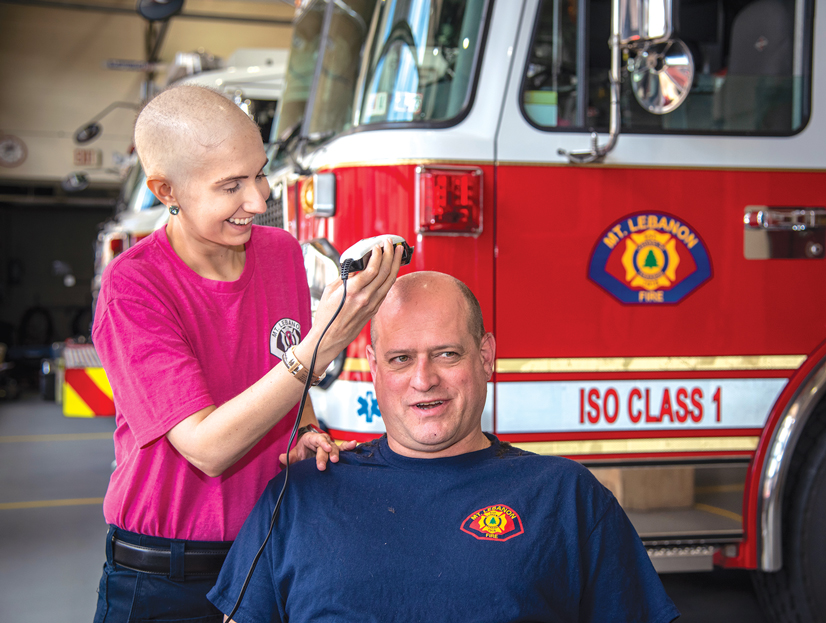
About that last “C” in the ventilation triad? Control? As patients begin to lose their hair from treatment, many find that shaving their head steals back some of the control from cancer. As Daugherty started to lose the thick swoop of her hairstyle, she wanted Chief Christofel to do the honors. On March 7, he answered that call in the apparatus bay of the public safety center, surrounded by fire trucks. She returned the favor by shaving his head to a cheering audience, including several firefighters, St. Clair’s Dr. Maropis, nurse Nicole Lavelle and medical assistant Ron Carson, plus friends and family.
“She is absolutely vibrant,” Hannah Kramer said of her friend.
Daugherty’s treatment plan has included chemo, immunotherapy and radiation. The tumors “are melting away,” she says and on some of her non-treatment days, she feels really good. Four times, her doctor has used the word “optimistic” to describe her situation. Most of all, she feels thankful for the fire department. “I was in bed the other night and feeling joyous,” she said. “I do think the fire department saved me.”
She explained her time in the department has given her mental resiliency that has helped her deal with her treatment. “It toughens you up in a way,” she said, noting if she can put on heavy equipment and carry it around, then “lying in a bed getting an IV is no big deal.”
 Full Story