


Community Creators: Brian Peters
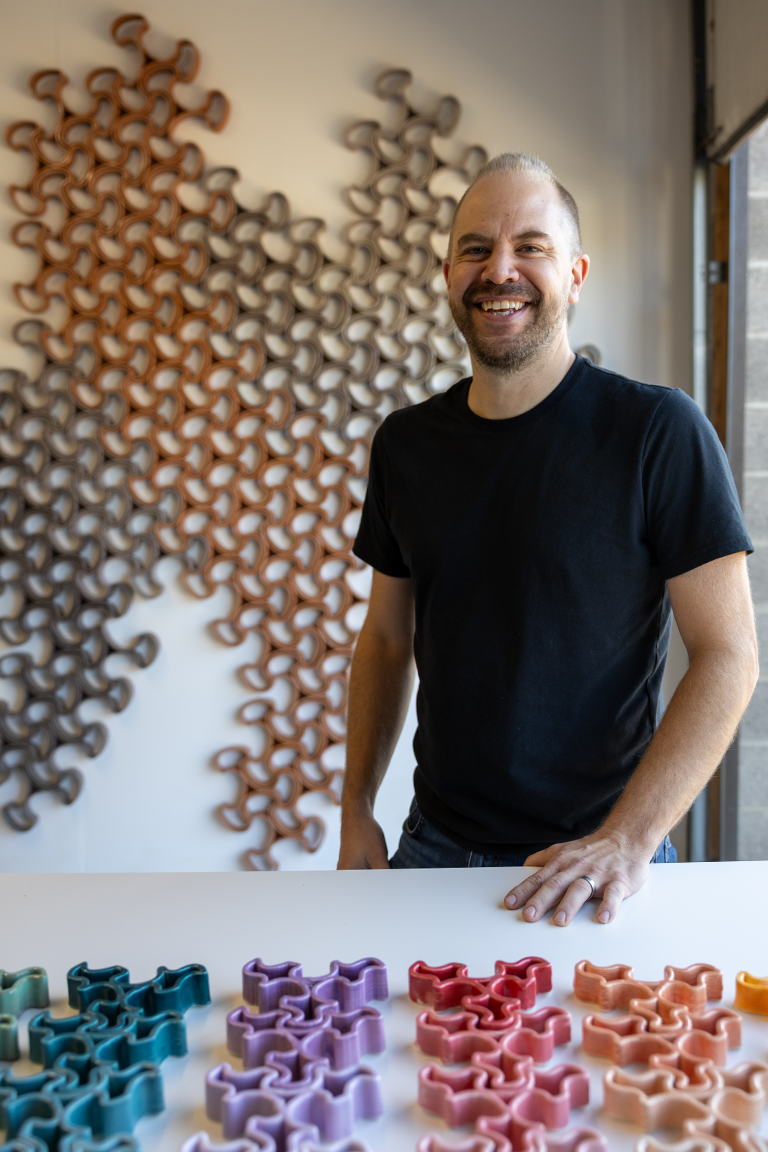
Artist and architect Brian Peters’ Carnegie studio, between Whiskey Run and Chartiers Creek, has prototype after prototype of ceramic fabrications, bags of clay and most impressively, three substantially large 3D printers.
Originally from Grand Rapids, Michigan, Peters, Glenridge Lane, earned his bachelor’s degree in studio art and a master’s in architecture at the University of Illinois, Chicago (UIC) before studying at the Institute of Advanced Architecture in Barcelona, Spain, where his career took a momentous shift during a residency at the European Ceramic Work Centre.
In his UIC days, 3D modeling technology was still new, “In 2005 it was just in its infancy,” he said. “While I was working as an architect it just started to come up more and more. I wanted to learn more about it.”
Peters found a school in Barcelona that specialized in architecture with 3D modeling and printing specifically in mind. “I ended up teaching there for about a year after I graduated, and then we moved to Amsterdam.” He had an opportunity to work for an architecture firm there and they asked him to come up with an idea for a temporary project. “I said, ‘Let’s build a gigantic 3D printer and make it a performative, sculptural piece.’”
Peters took his 3D printing knowledge, and his formal architectural practice and he turned it into a business. First with Building Bytes — a firm that specializes in fabricating with 3D printing technology using recycled plastics and bio-plastic material — and then with Coded Clay, Peters’ side hustle of digitally designed and fabricated ceramics. His artwork is something all its own.
“As an architect I think in modular construction, and as an architect I saw an opportunity to kind of rethink [the brick],” he said. “It’s something we’ve been doing for thousands of years, but the technology of the brick has been the same. It’s extruded, it’s nothing really that complicated, but 3D printing allows for these really complex shapes, and saves on energy and material. There’s all of these potential benefits.”
Peters’ bricks are printed one by one using 3D printing technology in his workshop. Sometimes it can take weeks to put together a project. Because he’s still using traditional ceramic methods of firing and glazing, his projects have the same issues that any pottery or ceramics professional would have — things don’t always come out right in the kiln, meaning lots of trial and error.
Peters packages “kits” of bricks and sends them out all over the world to be installed by masons or tile layers on behalf of his clients. He often works directly with art consultants or interior designers, “kitting out” his work so he can move more freely between larger, site-specific and museum installations. His award-winning techniques have earned him acclaim in the architectural world, and his practices are changing the way we envision the future.
All the clay that Peters uses comes from Standard Ceramic on the other side of the highway in Carnegie, making his products locally sourced, and a step towards sustainability.
Peters and his wife, Daphne, moved to Mt. Lebanon with their two children because of a job opportunity at Carnegie Mellon University School of Design. The four of them packed their belongings with sights set on Pittsburgh for the cost of living, and the big-little-city feel. “There’s great cultural institutions here for a city this size. You wouldn’t get museums like we have here anywhere else. Plus there’s great sports teams — it’s what the city is about. I like Pittsburgh too because it has such an amazing history of making things.”
 Full Story