


Community Creators: Kim Fox
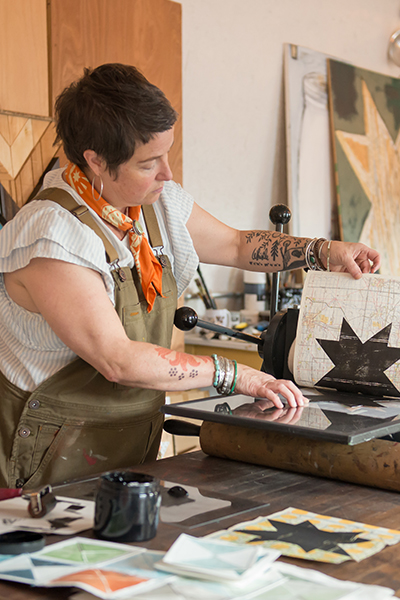
The Frick Environmental Center, Greater Pittsburgh Community Food Bank, mossArchitects and The Andy Warhol Museum are just a few organizations Academy Avenue resident Kim Fox has worked with in her artistic career. From paper collages, murals, reclaimed steel license plates on wood, paint on canvas, relief prints, to illustration and design work, Fox has had her hand in many mediums.
Fox, a Pennsylvania native, traded the Keystone State for the Sunshine State in her youth, but when it came to her art, she continued to be impacted by her rustic western Pennsylvania childhood. “I grew up out in the woods in the middle of nowhere,” said Fox.
“I had total freedom out in the woods,” she continued. “I rode my bike everywhere, camped all the time and my best friends lived on this beautiful farm. It was really a wonderful way to grow up.”
Fox was raised in the Pennsylvania countryside in the ’70s, and it’s no wonder that her work focuses on materials like wood, metal, and ink, often inspired by the Americana backdrop of a city like Pittsburgh — an urban landscape surrounded by nature but also in industrial decay. Crediting a contemporary craft workshop in found materials with Robert Villamagna as her introduction to tin and reclaimed materials, Fox’s main claim to fame is taking discarded objects like vintage tins and “weaving” them into something akin to quilting, then “embroidering” them with metal studs and attaching them to salvaged wood.
The legacy of the Gee’s Bend quiltmakers, a group of women in Alabama’s rural Black Belt in the Gee’s Bend area, who for generations, surviving slavery and Jim Crow, used recycled materials of flour sacks, old denim and work clothes to create quilts to stave off the cold, has also inspired Fox.
Fox pieces together her artwork in such a way that it resembles traditional patchwork quilting. From her own version of the Crystal Star to assembling metal maps of the United States, Fox is inventive in her approach.
Wintry scenes of rural life with horse-drawn carriages and festive pines elicit potent American folklore. As do the tins in which Fox uses. Emblematic of Warhol, Fox uses retro tins, packaged from common canisters like cookie tins or canned goods and re-packages them as art. Her work of houses piled up on a hill in gingham, tartan and polka-dotted tins mirrors Pittsburgh’s slopes and alludes to the sardine-like underpinning of the city’s topography and American consumer culture at large — highlighting, perhaps, that we too,
are encased.
“People are born here [Pittsburgh] and die here,” Fox said. For her, there’s history, there’s soul, and there’s life in Pittsburgh, unlike in Orlando, where she felt that there was more of a transient approach to living. “I missed the mountains. I missed real trees.” Keeping bees, living off the land and living creatively were all things that Fox was exposed to from a young
age, and specifically informed her work. “[I moved back here and] I kind of went full into Pennsylvania Dutch folk art. I love old things, and nature. That really came together in my artwork.”
Often finding more joy in the process than the outcome, Fox is more into doing than getting caught up in defining. This can be applied to her life in the city as well. “I love the idea that Pittsburgh is referred to as ‘the workshop for the world,’” she said. Among the tin pieces, you’ll find screen prints, ornaments, sculptures, ceramic pots and T-shirts in any artist booth of Fox’s. Focusing on one approach to art has never been in her wheelhouse; for Fox, an assemblage of different products is what drives her creative mind.
Worker Bird, Fox’s studio-brand identity, is also a patchwork combination of her life as a beekeeper, her admiration of bees, and their female-run communities, aka “worker,” as well as “bird,” a term of endearment from her husband, hence, “Worker Bird.” Fox’s art is rooted in symbolism, and environment, but her methods and practice informs her work.
When asked about the art world in Mt. Lebanon, Fox said she wants people to do more work. “I would love to see people do more DIY stuff,” says Fox, “Like, let’s do art shows in our garages.”
 Full Story