EIT increase of 0.2 percent following state Supreme Court decision
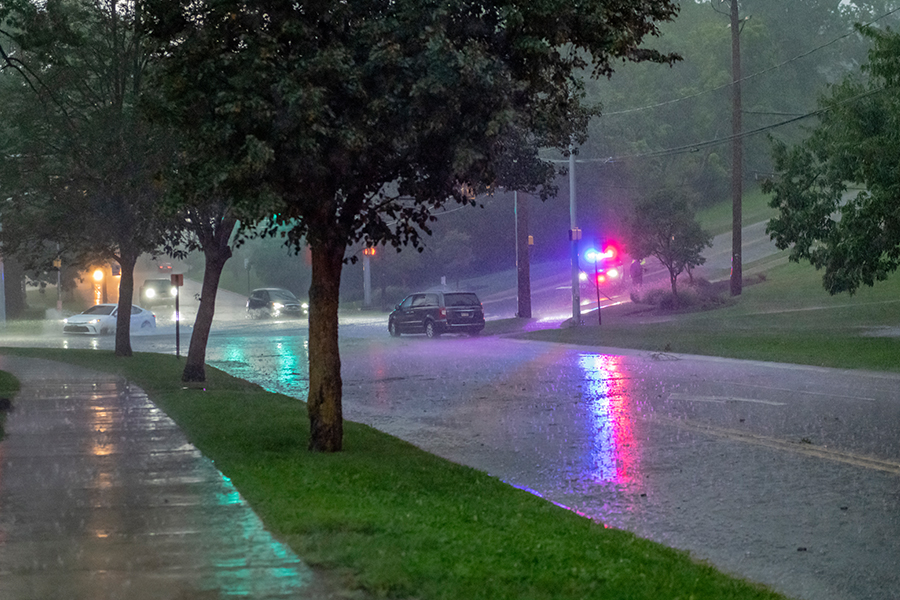
Around dinnertime Thursday, September 3, a late summer storm opened its mouth and blew into Mt. Lebanon, dumping up to three inches of rain an hour. Water rushed down our hills, pushing yard debris over storm sewer grates and overwhelming the system. The deluge sent the fire department on 52 calls, one of which was a stormwater rescue from a vehicle in the flooded lowlands of Cedar Boulevard.
Some residents pumped basements, curtailed local travel and lost food and sleep when soaked grounds and winds caused trees to fall on power lines, darkening neighborhoods.
We can’t control the weather, but Mt. Lebanon has tried to control the way our stormwater flows. Since 2014, we have invested more than $14.9 million in improving infrastructure, including large upgrades on Sleepy Hollow, Longuevue/Woodhaven, Elm Spring/Scrubgrass, Vallevista, the golf course and Bird Park.
Although there’s no financially responsible way to build a system that eliminates all flooding, we have significantly decreased flooding events and preserved residents’ property, municipal fields and municipal buildings. (For a complete report on all storm water projects, go to: mtlebanon.org/stormwater.)
It’s not enough. Many large capital projects remain and others are completed annually as streets are reconstructed.
We were one of the first towns in the state to institute a stormwater fee, in 2011, the proceeds of which have gone directly to such improvements. That fee didn’t just come from property owners; it was paid by nonprofits, which is important because our nonprofits have some of the largest impervious spaces in the municipality. Sizable parking lots and large buildings, including schools, senior care facilities and St. Clair Hospital, displace rainwater and cause runoff. But after an appeal this year from West Chester University of Pennsylvania, the Pennsylvania Supreme Court ruled such fees are tantamount to a tax. As a result, tax-exempt properties no longer have to pay it, shifting the burden back to homeowners and commercial entities.
At its September 8 discussion meeting, Commissioners heard a report from Finance Director Andrew McCreery, in anticipation of beginning the 2027 budget cycle. At issue, staff needed to know how the Commission preferred to pay for next year’s $2.3 million stormwater budget, including $1.6 million in capital upgrades.
If the whole amount were to be paid by property taxes, that would drive the millage up 0.85 mills. The Commission also heard about splitting the increase between property and earned income tax or even using some of Mt. Lebanon’s $1.2 million capital fund balance.
After discussion, a majority of the Commission preferred a 0.2 percent increase in the earned income tax rate. If approved along with the final budget in December, the increase would mean $200 in new taxes for every $100,000 of taxable income. Mt. Lebanon’s earned income tax would grow from 0.8 percent to 1 percent. The school district also levies a 0.5 percent EIT, so residents would pay a total of 1.5 percent in local income taxes if the proposal passes. The stormwater fee, which would have been $153.72 per household in 2027, would go away.
“We can either invest now and stay ahead of it,” said Commissioner Andrew Flynn, “or we can let it deteriorate and then really jack up taxes in 10, 20, 30 years. I’d rather get ahead of it and bite the bullet and say we’re proactively taking care of our community because it matters.”
The commission chose to fund the cost through the EIT instead of property taxes in part because it’s a slower increase. Working individuals will notice small increases deducted from each paycheck instead of having a large real estate tax bill in June. Additionally, Mt. Lebanon’s municipal income has been on the rise, especially mid-level earners bringing home $250,000 to $500,000 per household, which means tax proceeds are likely to grow in future years.
The Commission wanted the $1.2 million in the capital fund balance to stay in reserve, where it will earn interest in preparation for some large upcoming capital projects, such as the south garage reconstruction and improvements to the recreation center.
The $2.3 million budgeted for 2027 storm projects includes $563,370 in operating expenses (curbs replaced during our road resurfacing projects and storm sewer repairs), $122,050 in debt service and $1.6 million in capital expenses, including street reconstruction and storm sewer construction. The debt service is from a 2019 refinancing of a 2014 bond and will be paid off after next year.
Streets and curbs are a vital part of stormwater management as they funnel water into the appropriate drains.
The stormwater projects and the challenge of paying for them are not unique to Mt. Lebanon. A legislative solution could help the nearly 50 Pennsylvania municipalities who previously relied on a stormwater fee. Such a solution could ensure nonprofits pay for the service in much the same way they currently pay for electricity.
The new tax rate and stormwater project budget are subject to the Commission approving them during the budget process. At that point, they will also discuss the property tax millage in the context of other municipal costs, such as a significant increase in health insurance and road salt costs.
We’ll push out additional communications, including a postcard mailed to your home, after the budget is adopted.
 Full Story