Holding the line
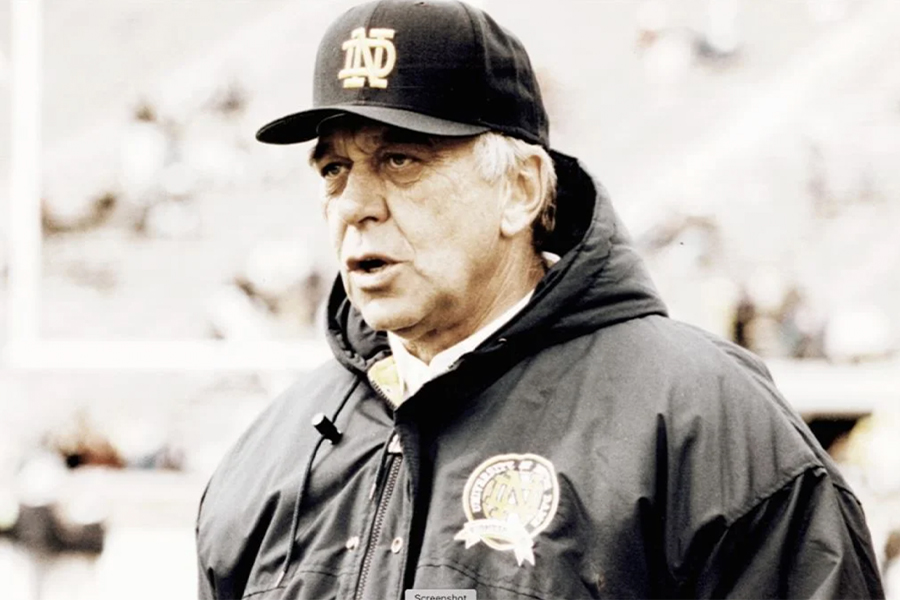
James Moore makes a priority of keeping his father’s legacy alive. And what a legacy. Joe Moore is widely considered the best offensive line coach in football history.
The Moore family lived on Newburn Drive, and James is a 1985 Lebo grad. While James had success in the sport with the Blue Devils — he was a quarterback and part of WPIAL championships in 1983 and ’84, before there was a state tournament — a shoulder injury kept him from making an impact beyond high school.
Still, football is in his blood.
“I’ve been around it my entire life,” James said of the sport and his father’s career. “We talked football a lot. We talked a lot about life as well.”
Joe Moore died in 2003 after a coaching career that took him from McDowell High School in Erie to Upper St. Clair High to Pitt, to Temple University and to Notre Dame.
“He started out as a running back coach. He asked to move to offensive line in ’79 (while at Pitt), and the rest is history,” said James Moore, who now lives in the Chartiers Valley School District, where his wife, Robin, teaches.
That history comes to life each summer with the Joe Moore O-Line Camp (joemooreolinecamp.com), and each college football season with the bestowing of the Joe Moore Award, which goes to the top offensive line.
James Moore and several prominent coaches work at the camp with high school linemen, who are too young to know much about Joe Moore. They get a lesson on his legacy, which includes coaching Pitt All-Americans such as Bill Fralic and Jimbo Covert, and sending 52 players he coached at Pitt and Notre Dame on to the NFL.
Russ Grimm, a center under Joe Moore’s tutelage at Pitt and now retired after a long NFL coaching career, remembers the elder Moore as tough but highly effective.
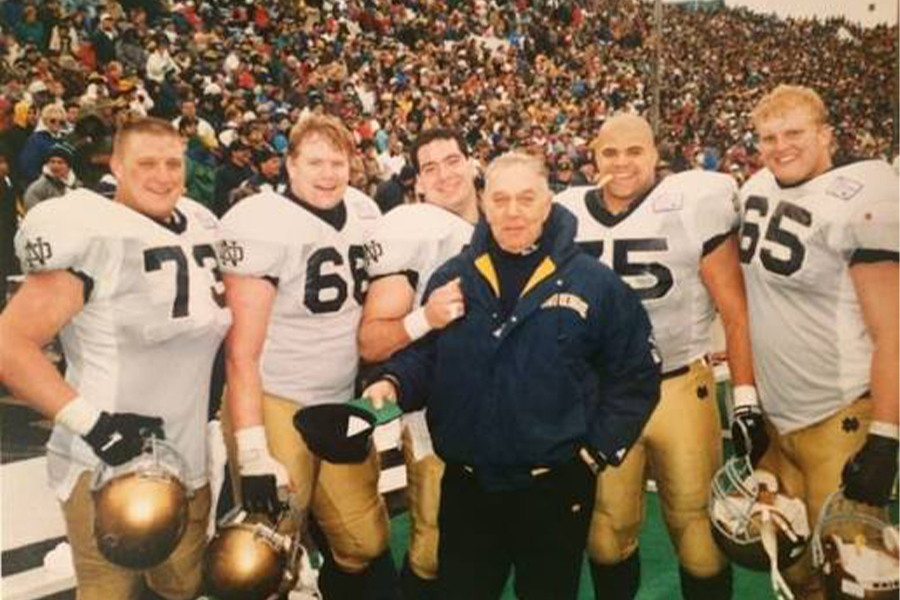 “When I first played for Joe, I hated it,” said Grimm, an early camp organizer who still helps out each summer. “But then once I realized where he put me and what he taught me, then I realized that yes, that was a great coach.”
Last year, 10 states were represented at the camp, including some schools that sent their entire offensive line. Blue-chippers are treated the same as fresh-faced ninth graders.
James Moore and other camp organizers have rounded up sponsors to help keep the cost low — he said the most a player pays is around $200. “That’s really helped on the financial side because now we can do more things as far as more gear for the kids, more beer for the coaches,” James Moore said.
Instructors at the camp over the years have included Grimm; Covert; Mt. Lebanon’s Andy Weidl, now in the Steelers front office; and successful high school coach Bill Cherpak.
None of the coaches are paid beyond a hotel room, meals, beverages and perhaps a golf shirt. They volunteer to help the young players, honor Joe Moore and for the chance to spend a couple evenings talking football with the other instructors.
What they teach is essentially what Joe Moore would have taught them.
“My father was all about repetition, repetition, repetition, so the fundamentals were exactly the way they should be,” James Moore said. “Of course, the techniques evolved a little bit, but everything is basically the same. The guy inside and low, he wins every time. How do you get inside and low? Some people say hands have to be inside. My dad always said elbows inside.”
James Moore, who also stays involved in sports and academic groups working for an innovative fundraising company and app called TapNPay+, loves the whole notion of legacy and connections. He is still friends with a group that he played with at Lebo.
He’s also extremely proud of the Joe Moore Award, the only major college football trophy that goes to a unit of players rather than an individual. The monstrous bronze trophy features five linemen and weighs 350 pounds, the largest college football trophy.
“Football’s the ultimate team sport, right?” James Moore said. “To be part of a team, that’s what the award’s about. It takes a team to lift it because it takes a team to win it.”

 Full Story