Moscow’s Mercenaries
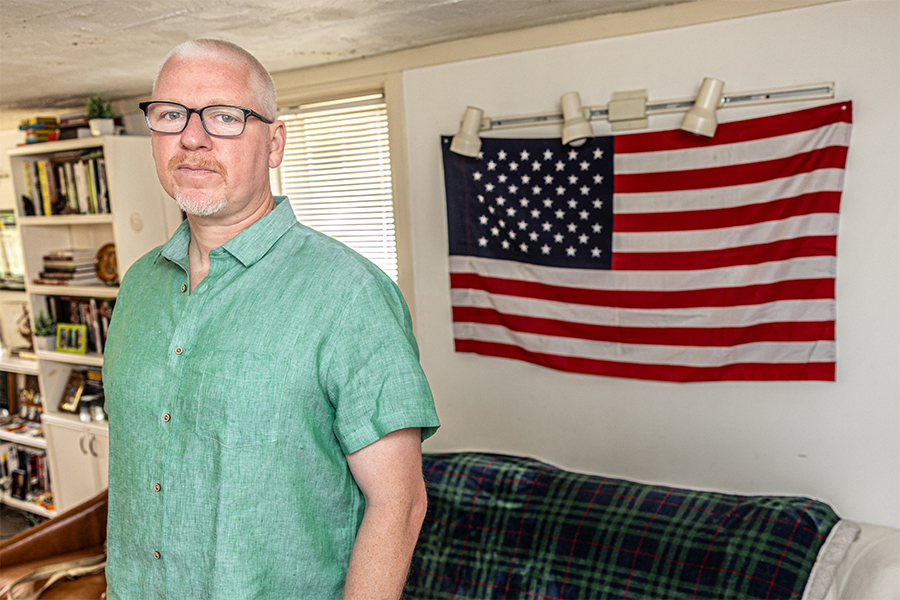
Colin Clarke of Inglewood Drive heard recently from a friend he had grown up with in Long Beach, New York. The friend reminded Clarke about a research project he did in fifth grade. Clarke’s subject: the history of weapons.
That interest “was always there,” Clarke said, and it’s one he has pursued in his education and career.
Clarke came to Pittsburgh in 2007 to attend the University of Pittsburgh’s Graduate School of Public and International Affairs, where he earned a doctorate in foreign policy and international security policy after receiving degrees from New York University and Loyola University Maryland. He worked at the RAND Corporation and has taught at the University of Pittsburgh and Carnegie Mellon University.
Currently, Clarke is executive director of The Soufan Center, a nonprofit organization that provides research, analysis and strategies to combat terrorism. Clarke’s considered an authority on global threats and is often seen on CNN, MS NOW, and other news outlets. He contributes to The Atlantic, The New York Times and the Washington Post. He’s even been recognized at The Saloon.
“We were out for beer and wings,” Clarke recalled, noting that it was “strange” but “flattering.”
Notoriety aside, Clarke’s job is not for the faint of heart. Through open-source software and access to the dark web, he keeps track of terrorist activities, which can include videos of violent attacks.
“I have to watch all of them,” he said. “You become desensitized to extreme violence.”
Clarke and his colleagues also monitor jihadist chatrooms. Recently, participants have been debating the theology around artificial intelligence and its use in terrorist attacks, he said: “They’re wondering if it’s permitted in Islam.”
If those monitoring the chats suspect that an action is imminent, they will notify federal authorities, Clarke said. “It’s a rare occurrence, thankfully, although it does happen.”
As an expert, Clarke believes that the Trump administration’s approach to defending against terrorism has made the country more vulnerable. He cited the White House Counterterrorism Strategy, released in May, which listed “Narcoterrorists, Legacy Islamic terrorists and Violent Left-Wing Extremists, including Anarchists and Anti-Fascists” as the country’s gravest threats.
“They’re politicizing counterterrorism,” he said. “They have a strange obsession with transgender ideology,” noting that the word “transgender” appears in the strategy report as often as the Lebanese Islamist group Hezbollah.
“This has zero to do with counterterrorism,” Clarke added. “It’s un-American. When a terrorist bomb goes off, it doesn’t discriminate between Republicans and Democrats. You can’t cherry-pick who you’re going to protect.”
Citing his expertise, as well as data analysis by nonpartisan counterterrorism experts, Clarke believes the most serious threats to American security are Sunni jihadists, including groups like al-Qaeda and ISIS; Shia (Hezbollah) jihadists; and far-right domestic extremists like neo-Nazis and white supremacists. The Trump administration strategy “has not one mention of far-right terrorism,” he noted.
The author or co-author of six books, Clarke contributed to Moscow’s Mercenaries, published in June by Columbia University Press. It focuses on the Wagner Group, a Russian state-funded private military that has fought for Russian interests in Ukraine, Syria and Libya, among other countries. The group’s leader, Yevgeny Prigozhin, a former ally of Vladimir Putin who led a mutiny against him, died in a suspicious plane crash after meeting with Putin in 2023.
Calling it a “passion project,” Clarke added, “It’s not a book you’re likely to see in the airport or at Costco.” He characterized it as “academic lite.”
Despite the demands of his job, which include regular international travel, “I truly love what I do. I wouldn’t trade it for anything,” Clarke said.
He and his family also love Mt. Lebanon; they moved here in 2019. “I don’t ever want to move,” Clarke said. “If someone were to ask me what my greatest career accomplishment has been, I’d say it’s staying in national security work and not having to leave Pittsburgh.”
Colleen Clarke, Colin’s wife, is a nurse who played professional basketball in Europe after graduating from college. Their daughters, Fiona and Maya, attend Markham Elementary. They’re active in sports, and Colleen has coached them in basketball and field hockey. In the summer, the family spends time at the Bower Hill Swim Club. They enjoy visits to the library, the farmers market, Bird Park, and Totopo, and hanging out with Benny, their goldendoodle.
Earlier this year, Clarke joined the board of Eradicate Hate, a Pittsburgh-based nonprofit with a mission to combat hate-fueled violence. The organization was formed in response to the 2018 murders at Tree of Life Synagogue. Clarke lived in Squirrel Hill at the time and said he was shaken by the attack.
“We were thrilled to welcome Dr. Clarke to the board of directors,” said Eradicate Hate president Brette Steele. “He’s been a trusted advisor to the global summit since its inception. His expertise, perspective, and longstanding commitment to our mission make him an ideal addition to our board.”

 Full Story