



Publicizing the new airport terminal is a Lebo thing
The Pittsburgh International Airport’s new $1.7 billion terminal is now known as the front door for the region and two Mt. Lebanon residents have been out front, sharing its story years before the grand opening.
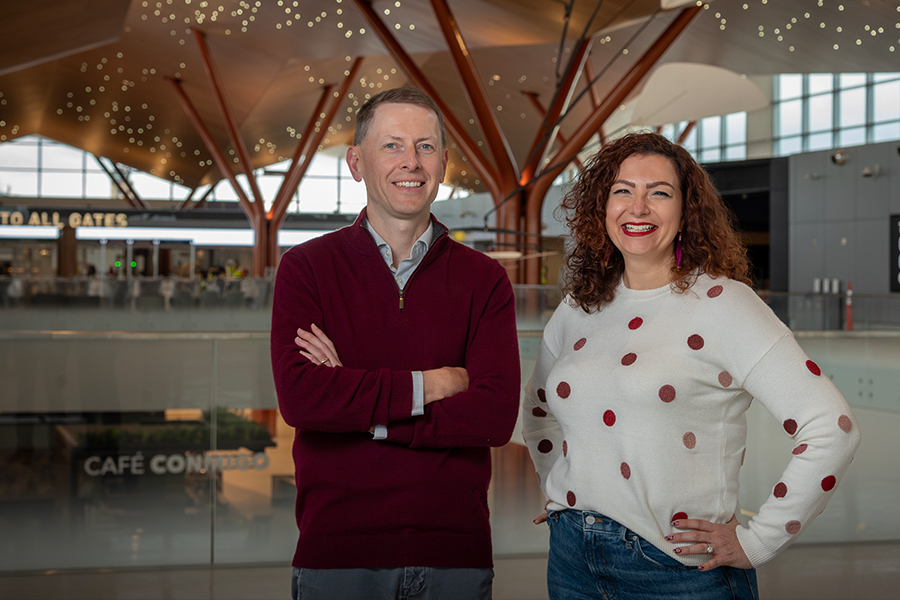
Bob Kerlik, Arden Road, the airport’s director of public affairs, and Rachel Carlson, North Meadowcroft Avenue, its social media manager, are key members of the 15-person communications effort, which includes detailing the region’s largest infrastructure project in decades.
Kerlik and Carlson are joined by several other Mt. Lebanonites on the marketing and communications team: Kate Toth, director of marketing; Gina Mastrangelo, communications manager; Andrew Davidson, marketing manager and Christina DuThinh, manager, executive communications.
Mt. Lebanon is also well represented in other departments of airport work.
At a whirlwind private tour weeks before the scheduled opening date, Kerlik and Carlson pointed out the highlights. The new terminal features 13 security lanes, four outdoor terraces, adjacent indoor and outdoor parking and a design inspired by the hills and forests of western Pennsylvania. Inside, massive high rolling ceilings filled with 4,500 tiny lights resembling constellations trailblaze a clear path to the security area. More than 100,000 square feet of glass lets in plenty of natural light, reflecting off what seems like miles of white and silver Terrazzo flooring. The finishes and lighting create what Kerlik described as “a wow factor” representing “the Pittsburgh of today.”
Carlson expects travelers to be just as struck by the design. “The ceiling is such an Instagrammable moment,” she said.
The airport is still divided into “landside” (ticketing, baggage check/retrieval and security) and “airside” (gates, shopping and dining) buildings, but now they are connected, eliminating the need for a people mover train and cutting travel time from curb to gate in half. When leaving security for the airside terminal, travelers cross the Skybridge — a ramp flanked with bridge imagery and immersive video screens.
Walking is smooth with no more clack-clack of luggage wheels. Ticketing counters are bright and easy to locate, and the entire lobby architecture directs you where to go, even though bright signs are there to help. Seating, including charging ports, is clustered everywhere.
Travelers can also get their luggage in less than half the time. “We’ve eliminated eight miles of baggage belts,” Kerlik said.
Restroom stalls feature doors that open out so you can easily take your bags in with you. In the lobby, steel supports are made to resemble 32 trees — each one different, with metallic replicas of leaves embedded in the flooring nearby. Artwork is everywhere, including on baggage carousels, where clever phrases depict what your luggage might be thinking.
Built “for Pittsburgh by Pittsburgh,” about 90 percent of the materials and labor came from the region, generating an estimated $2.5 billion in economic impact, without using local tax money.
The opening also brings upgrades to the existing airside terminal, including new seating, additional outlets and more than 20 new stores and restaurants. Among the local favorites are Mineo’s Pizza, Café Conmigo and Duquesne Supply Company, which sells locally made goods from companies such as Love Pittsburgh, whose co-owner lives in Mt. Lebanon.
Public feedback indicates the new design is creating a sense of optimism about the future, the team says. Although many airports must incentivize participation in tests and open houses, Pittsburghers practically climbed over each other to see it before opening. More than 10,000 signed up for its first open house and 18,000 wanted to be part of its test run, although that list had to be trimmed to 2,500.
The project, led by Airport Authority CEO Christina Cassotis, replaces the 1992-era terminal originally designed for US Airways’ hub operations. When the airline discontinued the hub in 2004, the airport was left with facilities meant for connecting-flight passengers rather than local travelers.
“Back when this terminal opened, 80 percent of our passengers were connecting,” said Kerlik, who has been with the project before it began. “Today, the connecting passengers are gone, and 97 percent of our traffic is [origin and destination] traffic, people coming to and from Pittsburgh.” Now, more than 10 million people use the airport each year.
Carlson, who joined the airport in 2023, said documenting the project’s progress became one of her favorite parts of the job.
“I was thinking how daunting that would be … I’m not from construction … but it’s become one of my favorite things to share on social media because Pittsburghers are so excited to see it,” she said.
Her weekly posts featuring behind-the-scenes updates quickly became among the airport’s most popular. “Anytime I post about the terminal, it’s literally an instant hit,” she said.
At neighborhood events and youth sports games, Kerlik and Carlson often field questions from curious parents. “When I say I work at the airport, people light up,” said Carlson. “It’s a fun job to talk about.”
The job is not without its challenges. Kerlik said not only were they charged with helping the public understand the reasoning and key benefits of the terminal modernization project, where information changed often — something he described as “changing the wheels on a moving bus” — but they also had to balance that work with their regular jobs, including communicating new service routes and other critical travel information.
As passengers move through the bright new terminal and public feedback rolls in, both Kerlik and Carlson say they feel a sense of pride that goes beyond their professional roles.
“It’s been amazing to see our neighbors’ excitement — both online and in person,” Carlson said. “It’s just an exciting time.”

 Full Story