



Street Smarts
Mt. Lebanon spends seven figures a year on keeping its 88 miles of streets roadworthy. The municipality is not responsible for every surface in town, as some roads are maintained by the county or the state, and homeowners who live on private streets are responsible for paving (see sidebar at the bottom of this article, Who does what?).
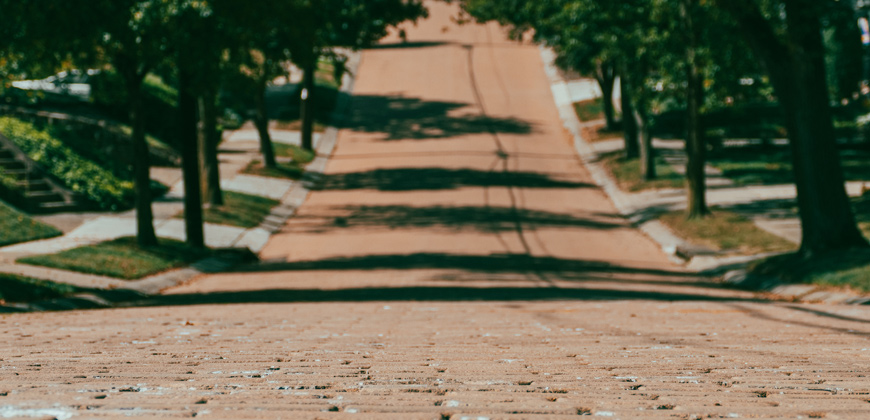
The majority of the streets are asphalt, with about 9½ miles of brick streets. A few concrete streets remain, mostly in the Cedarhurst Manor area, but as they wear out, the plan is to replace them with asphalt.
“The concrete these days just doesn’t hold up like the concrete in the past,” said Public Works Director Rudy Sukal.
One of the reasons, he believes, is the use of more salt and other deicing materials that are detrimental to concrete.
“Back in the day, they used cinders, sand, not a lot of chemicals.”
Concrete still has a use in curb construction.
“We use concrete curbing on all our streets,” Sukal said. “That’s not typical. Most communities use something like asphalt corner curbing, or other materials. It’s [concrete curbing] a little more expensive, but it holds up a lot longer.”
Brick streets
Sukal says the challenge in maintaining brick streets is the lack of paving bricks that match the original style. Today’s paving bricks don’t have the same dimensions or thickness as the bricks from about 100 years ago, when the streets were built.
“You can’t patch a piece of street with the newer bricks,” Sukal said. “You have to rip a piece out, put the new bricks in from curb to curb, and use whatever [old] bricks are still in decent condition to patch other areas.
“Like if the water company comes through and does a trench — we have them pull all the bricks out, but you’re going to lose at least 25 percent, maybe as much as 50 percent, just from age. They’ve been there for 100 years.”
In a 2021 survey, 96 percent of residents believed brick streets contributed to the character and historic charm of the neighborhood, and 70 percent believed that brick streets enhance property values.
In 2023, the municipality adopted a policy for the preservation of its brick streets. The policy classified all Mt. Lebanon brick streets into one of two categories — Preserve as Brick or Replace at the End of Useful Life. Factors that informed the decisions include the location of the street in respect to the Mt Lebanon Historic District; the surrounding streets in the neighborhood to determine if the brick street was part of a larger network of brick streets; the impact on safety due to grades, slopes, turns, precipitation, winter operations, amount of daily use or other variables; and the cost of maintaining the street as a brick street as compared to asphalt or other materials.
Private roads
At the start of Mt. Lebanon’s development, about a century ago, developers had the choice of whether to build streets in accordance with municipal standards — something that our present-day codes don’t allow.
“The codes are a lot tighter now,” Sukal said. “Any new street has to meet our standards.”
Although the municipality will plow and salt private roads, homeowners are responsible for the roads’ maintenance. If the residents want to turn the responsibility over to Mt. Lebanon, the municipality has a policy for transitioning from a private to a public street. The process begins with a petition that must be signed by all property owners on the street, ensuring that they are willing to contribute to the cost of the upgrade. The petition must be accompanied by a written explanation that explains the reason for the request, and a $1,500 deposit which will be used for engineering and other expenses.
Once residents submit the petition, municipal engineers will assess the street and come up with a preliminary cost estimate. The municipality calibrates its contribution to bringing the streets up to code based on the level of public use. For streets with a high level of through traffic and connection to public streets, Mt. Lebanon will fund up to 75 percent of the cost; streets with a moderate level of public use receive up to half the cost, and 25 percent for streets considered to have a low level of public use.
Making the list
Mt. Lebanon and Gateway Engineers determine which streets need work using a software program that assigns each segment of roadway with a Pavement Condition Index (PCI) number, between 0 and 100. Technicians make the evaluations based on several factors, such as the type of roadway, the classification of roadway (collector, local, cul-de-cac or alley) and age. Streets with a rating below 65 are considered either marginal or failing.
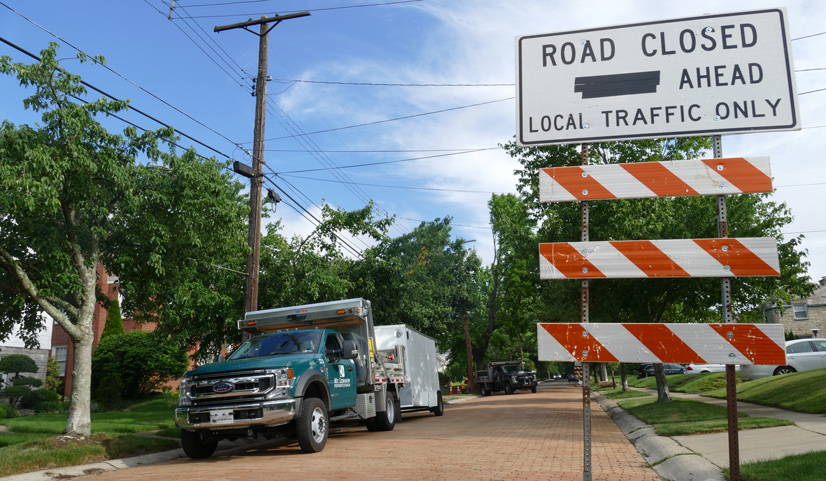
Once the list is compiled and approved by the Commission, the orange cones begin to sprout. Reconstruction involves replacing the curb, which can take a few weeks depending on the weather, as the new curb is covered with a curing compound to protect the curb until it becomes fully dry and durable; once the curing process is done, the curb and sidewalks are sealed with a compound that will protect them from road salt. Some storm and sanitary sewers, manholes and utilities can also be reconstructed at the same time, reducing the need to re-open the street for future repairs.
Once the new curbs are installed, the street’s surface and base is removed, which means digging as deep as 18 inches. Contractors decide how much of the base needs replacing. After these areas are repaired, a stabilizing fabric will be applied to the sub-grade, followed by a 6-inch layer of aggregate base, placed on top of the fabric, and the street will be graded to provide a crown in the center that will help with drainage. Then, a bituminous base will be placed on top of the aggregate base.
The final surfaces are applied in two 1½-inch layers. To keep out moisture, a hot bituminous seal is applied to the joints where the surface meets the curb. You will not be able to drive on your street for at least three days. If you live in the affected area, the contractor will notify you about 12 hours before beginning this process.
Navigating street repairs
Everyone likes the finished product. No one likes the process. Any construction project brings some temporary inconvenience.
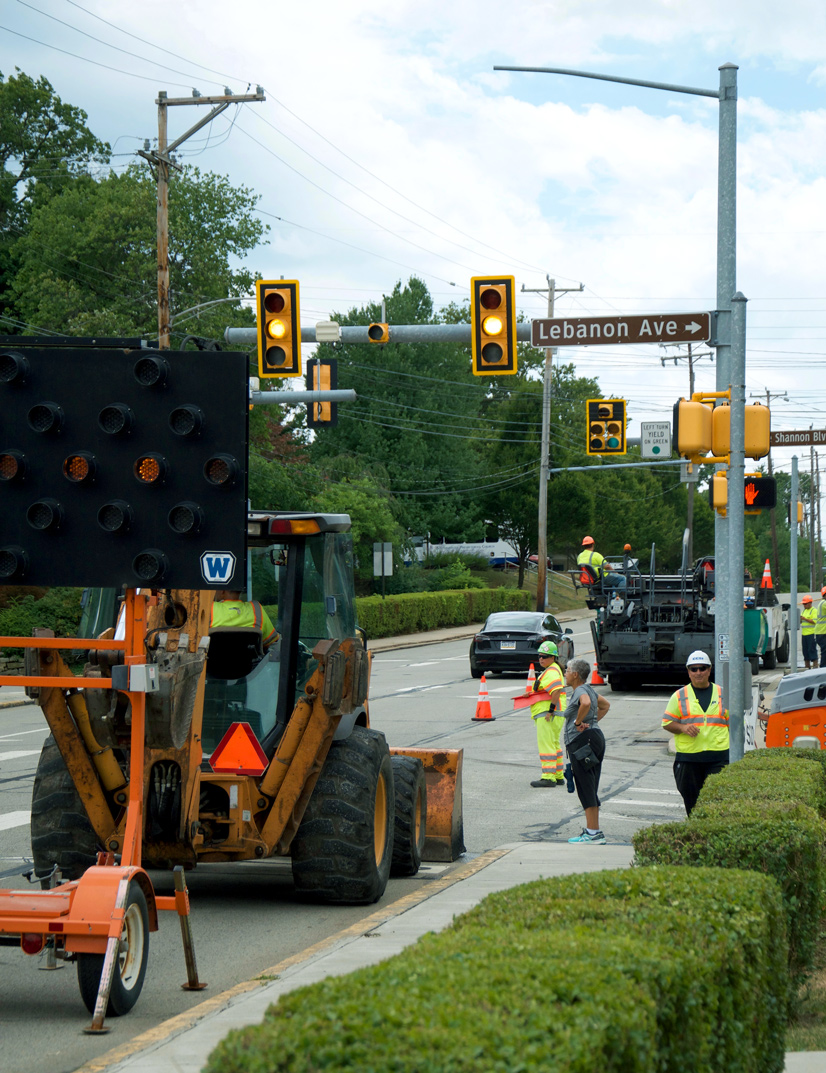
In certain phases of the construction, you will not be able to park on your street. The contractor will leave a notice at your front door a few days before construction begins.
When you can’t use your street or driveway, you may park during the day and overnight on nearby streets where it is legal. You do not have to contact the police department. The municipality will notify the police department for you.
Emergency services, trash collection and mail delivery will continue during the project. If you are expecting a large delivery while your street is under construction, call the municipal engineer at 412-409-2398 and the municipality will try to accommodate your schedule. If you have an irrigation system or an invisible dog fence, let the contractor know before work begins.
As with any construction project, use caution when driving or walking through the work area. If you need to move a barricade be sure to replace it immediately.
For several weeks after construction is completed, the road surface will be tacky, especially on hot days. Asphalt is difficult to remove from skin, clothing and hair, so be careful not to track it into the house.
For the first few months, turning a car’s front wheels sharply, particularly if it is not in motion, can damage the surface. Also, the new road surface is susceptible to erosion caused by gasoline or oil spills. For work schedules and an interactive map, visit mtlebanon.org/roadconstruction.
Who does what?
Mt. Lebanon plows and salts all roadways, but not all of the streets are maintained by the municipality. The list below details which roads are private and which are maintained by the county or the state.
State roads
Castle Shannon Boulevard
Cochran Road
Connor Road
Gilkeson Road
Kelso Road
McFarland Road
Mt. Lebanon Boulevard
Robb Hollow Road
Scott Road
Segar Road
Washington Road
County roads
Bower Hill Road from Cochran Road to the Scott Township border
McMonagle Road
McNeilly Road
Midland Street
Painters Run Road
Private roads
Adeline Avenue from Hilf Street to dead end
Allenberry Circle side roads
Arlington Park
Audubon Avenue Country Club to #563
Broadmoor Avenue from Kenilworth Drive to Rock Springs Road
Crystal Drive from Country Club Drive to dead end
Forest Glen Drive
Gypsy Lane
Hartle Lane
Hoodridge Lane (partially private)
Kenforest Drive
Kenilworth Drive from Country Club Drive to dead end
Kingsberry Circle
Lindendale Drive (partially private)
Lindenwood Avenue
Locust Lane
Miami Avenue dead end section at 900 Miami
Oak Forest Drive
Oak Way South Meadowcroft to Clokey
Orchard Lane
Overlook Drive dead end to brick section
Parkridge Lane
Pennsylvania Boulevard from Poplar Drive to dead end
Poplar Drive from Hazel Drive to Parkway Drive
Queensberry Circle side roads
Racine Avenue
Rock Springs Road
Rosbury Place
Royal Court side roads
Shadowlawn Avenue from North Meadowcroft to 330 Shadowlawn
Shady Lane
Summer Place from Parkview Drive to Austin Avenue
Terraceview Drive
Thornberry Circle side roads
Towercrest Drive
Westover Road
Whitby Lane
Youngwood Road

 Full Story