


Weaving the story of the Benares
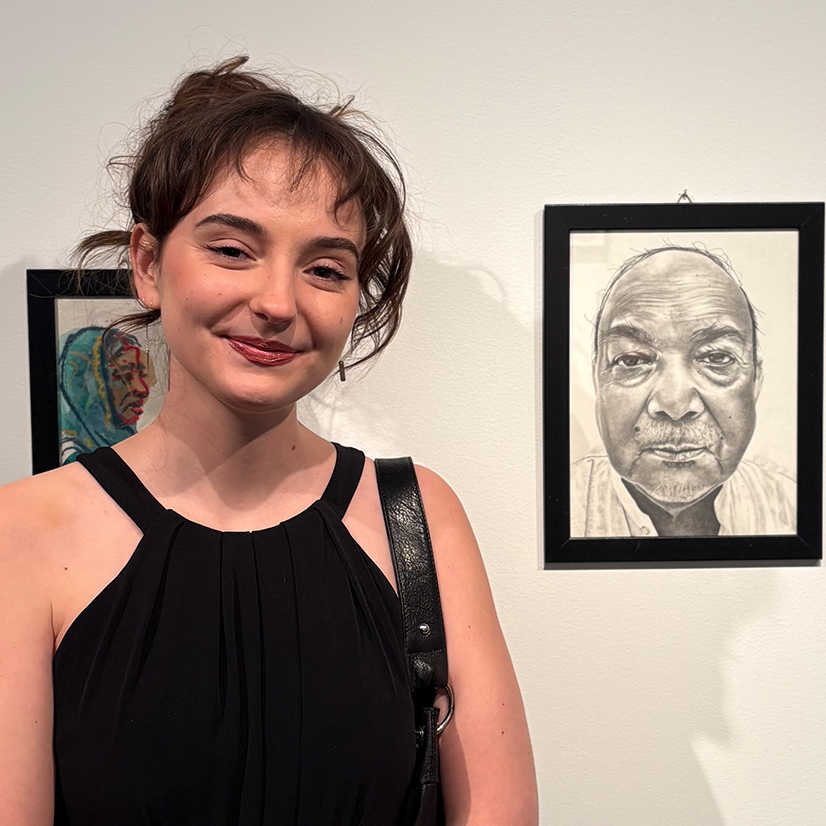
Natalie Callahan’s exhibition, The Weavers of Benares, highlights struggle and resilience in a community of traditional weavers in Varanasi, India, but the takeaway message is universal.
“Even though these circumstances are specific to this community, I think there are a lot of things that can be learned from what they’re dealing with in the modern arts world,” she said. “Being aware of other people’s circumstances is really important.”
After a nine-month Fulbright fellowship in India, the 2023 Chatham University graduate returned to campus with an exhibition on Indian weaving and artistic growth.
Callahan created the artwork during her time in Varanasi, a city in the northern Indian state of Uttar Pradesh that is known for producing fine silks and Banarasi saris. The exhibition brings together graphite portraits, pen-and-ink sketches and experimental pieces in watercolor and oil pastel.
Callahan was affiliated with Banaras Hindu University, though much of her work took place beyond the classroom. While she hosted an arts management workshop and spoke at conferences, her day-to-day work centered on community engagement and independent research.
One of the people who most influenced her during her stay was Ajay Pandey, who served as her local liaison, landlord and Hindi tutor. “I genuinely could not have done it without him,” Callahan said.
Callahan’s work focused on the weavers of Varanasi, a community known for its intricate handloom textiles. Through portraiture and observational sketches, she documented not just their work, but their daily lives.
The community, Callahan noted, faces mounting challenges. Many weavers are part of a Muslim minority in a predominantly Hindu city, which creates social and political vulnerability. Plus, economic shifts — particularly the expansion of power looms since the 1990s — have undercut demand for handmade textiles.
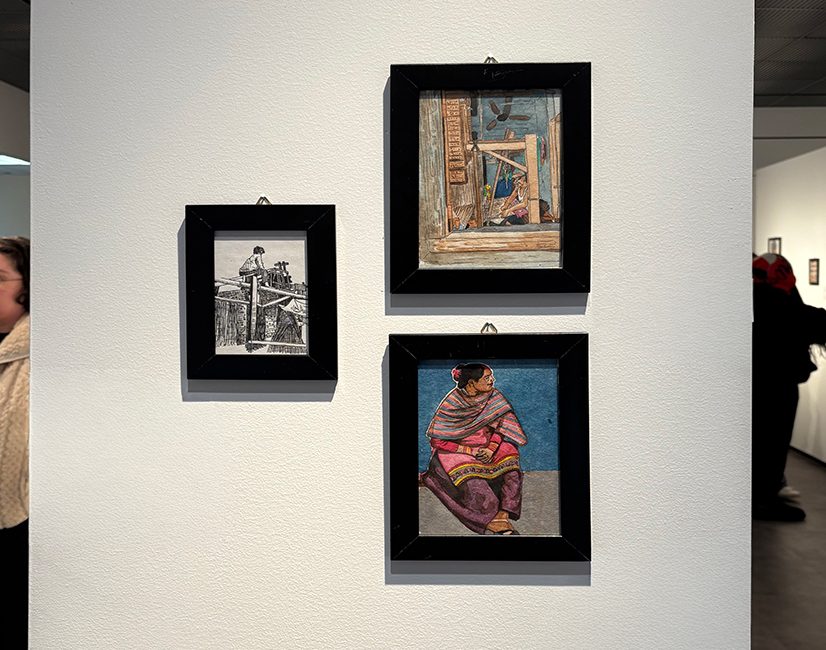
“When restrictions on what could be created by power looms were lifted in the city, the handloom artists really suffered,” she explained. “There’s a lot of exploitation since the weavers don’t have a direct line to the market.”
Callahan hopes her exhibition encourages viewers to think more deeply about the labor behind traditional crafts and the human cost of industrialization.
The cultural immersion had a personal impact on Callahan, who said, “I met people who are going to stay with me for the rest of my life.”
A member of Mt. Lebanon High School’s Class of 2019, Callahan is based in Squirrel Hill and works as a department assistant with the Arts Ed Collaborative, an independent project at the Carnegie Museum of Art. The organization connects schools, teachers and arts organizations to strengthen arts education across school districts.
While Callahan hopes people gain a broader awareness of global artistic communities and the realities they face, there’s one takeaway she’s eager to share beyond the gallery. “Everyone should visit India,” she said. “I learned so much and it’s a beautiful country.”
 Full Story