


A leader in engineering, from space flight to the classroom
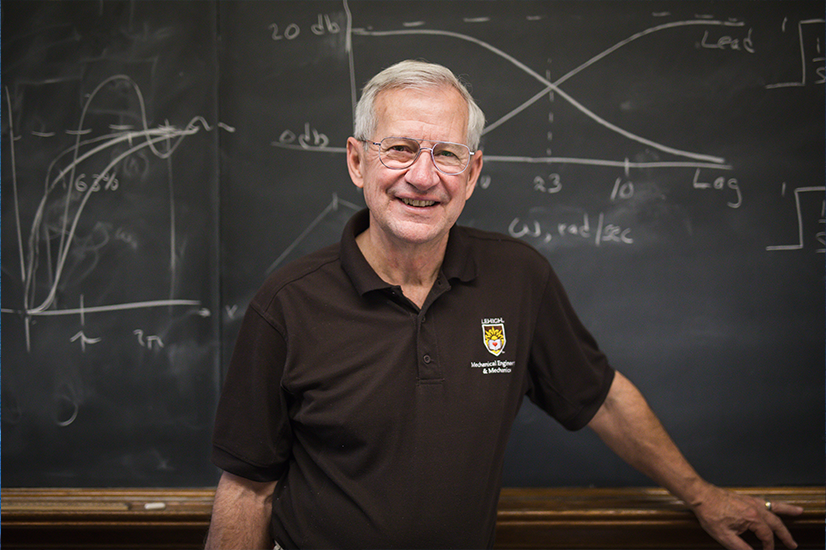
Scientist, fighter pilot, astronaut, telecommunications engineer, professor, husband and father … the list of roles in Terry Hart’s life are practically endless. He’s accomplished an incredible amount in the time since he left his hometown.
Hart manned the Challenger Space Shuttle mission STS-41C, which launched April 6, 1984. It was the Challenger’s fifth space flight and NASA’s first satellite retrieval mission, a complicated task according to Hart.
Growing up, Hart lived in three different Mt. Lebanon homes, but the one where he stayed the longest was 34 Meridian Drive. Throughout the ‘50s and early ‘60s, he and his friends rode bikes through the neighborhoods and walked to the Mt. Lebanon Golf Course, just down the road from his home. Although an only child, he had 26 cousins nearby (20 of whom still live in Pittsburgh today.)
Even in childhood, Hart said “being an engineer was in my DNA.” He recalled an innate fascination with how things work, taking them apart and examining the inner mechanisms. An indication of an emerging engineer.
Hart progressed from Howe Elementary to Mellon Junior High and then Mt. Lebanon High School, where he graduated in the Class of 1964. An impactful, early mentor was high school physics teacher Robert Zacur. During that time, space discovery was still in its infancy, so Hart strictly focused on physics and engineering. The first Apollo mission embarked in 1961, when he was a freshman. Hart visited his alma mater several years later following his own NASA mission and he reconnected with Zacur, who was still teaching at the school.
Hart left Mt. Lebanon to attend Lehigh University, where he earned his bachelor’s degree in mechanical engineering, and then Massachusetts Institute of Technology for a master’s degree in mechanical engineering. He later earned a second master’s degree in electrical engineering from Rutgers University. Out of school, he worked on the Safeguard Program for the Department of Defense, which was an anti-ballistic missile system designed to protect the US’s nuclear deterrent fleet. In 1969, Hart enlisted in the Air Force, where he flew fighter jets. As the Vietnam War neared the end, Hart transitioned to Air Force Reserve, retiring in 1990 as a lieutenant colonel. He logged more than 3,000 hours of flying time.
Returning to Bell Laboratories after active duty, Hart said he “wasn’t looking to make a career change” but was intrigued by a NASA vacancy announcement. It was the first time NASA was hiring since Apollo, years before when he was a teenager in high school. Hart didn’t expect to be picked, but after passing a physical, psychological evaluations and a selection board panel, NASA chose him to join the new class of astronauts in 1978. The first women hired at NASA were in this group, including Sally Ride, Hart’s friend and officemate for four years. Within six months, Hart and his family relocated to Houston, where he completed training and served as CAPCOM in the Mission Control, before taking flight.

Training was extensive and Hart learned from many mentors, including astronauts who had been to the moon. “The teamwork at NASA is just spectacular … It was one big group of super-qualified people that were focused on the mission of getting the spacecraft airborne,” he said.
Hart put in long hours preparing for flight, spending up to three days nonstop in simulators. The crew successfully located the Solar Maximum satellite, which studied the sun but malfunctioned after a year in orbit, repaired and released it. Hart also filmed an IMAX feature, The Dream is Alive, from the spacecraft.
Hart explained that “going on a space mission is almost like going camping. You have to take all your equipment with you … and it takes training.” One difference Hart noted between camping and space travel: “You see the world in three dimensions. It’s really awe-inspiring. It’s the kind of thing you never quite get over.”
STS-41C travelled 2.9 million miles, completed 108 revolutions and spent nearly seven days in space. Fun fact: the astronauts brought 3,300 honeybees along, to test whether they could make honeycombs in a microgravity environment, and found that yes, bees can make honey in space.
Shortly after, Hart left NASA and returned to the private sector, working for AT&T as director of its Skynet satellites. Hart oversaw many of the satellites that still power televisions to this day. In 1997, AT&T sold their satellite operations to Loral Space & Communications. Hart became president of Loral and ran their satellite program for the next seven years, launching 10 satellites into space. He “retired” in 2004, but still wasn’t ready to slow down. “I’m not the kind of person that could retire,” Hart remarked. That’s when he returned to Lehigh University, this time as a faculty member in their growing aerospace engineering program.
At 78, Hart remains enthusiastic about teaching, as he said, “young people keep you young.” He lives in New Jersey, with his wife Mary Jane McKeever, and has two daughters and one son. He encourages any young student interested in STEM to pursue it. “All forms of technology have become so beneficial to making life better for everybody. It’s so much fun being a part of that.”

 Full Story