More Than Firefighters
When a medical emergency happens in Mt. Lebanon, you may notice the first responders arriving in a fire engine rather than an ambulance.
For a fire department, answering medical calls may once have meant carrying equipment or helping move a patient. Today, it can mean arriving at a cardiac arrest, assessing a patient, administering medication or performing lifesaving interventions.
It’s a change that hasn’t happened overnight.
In the early 2010s, the Mt. Lebanon Fire Department (MLFD) began assisting Medical Rescue Team South Authority (MRTSA) on emergency medical service (EMS) calls. At that time, career fire department staff were required to become certified emergency medical technicians (EMTs). Still, the fire department’s role was limited. Firefighters were not automatically dispatched to medical calls, but they were summoned when medics needed more help.
In 2014, the department became a Quick Response Service (QRS) certified agency, which allows medically trained firefighters to provide patient care. The department does not operate an ambulance or transport patients, but it does use specially certified vehicles.
As part of the certification process, the Pennsylvania Department of Health inspects the department’s vehicles, which must contain required equipment including:
• Basic life support bag with first aid and diagnostic equipment
• Automated external defibrillator (AED) suitable for adults and pediatrics
• Oxygen with tools to manage an airway
• Portable suction unit
• Personal protective equipment (gloves, gowns, masks)
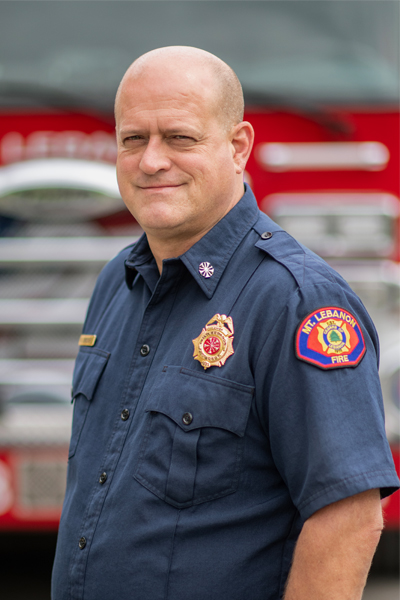
The department initially certified multiple engines, its rescue truck and a squad vehicle. The certification comes with ongoing responsibilities and costs, as vehicles must be recertified, inspected and equipped on a regular basis.
Initially, the department’s EMS response remained limited. MLFD responded to the highest-priority calls when MRTSA was unavailable or specifically requested by the fire department.
EMS calls are prioritized from zero to four, with zero representing the highest-priority emergencies, such as someone who is not breathing or is in cardiac arrest. At the other end of the scale, a four could involve something minor, such as a stubbed toe.
Today, the department is automatically dispatched to every E-0 call in Mt. Lebanon, regardless of whether MRTSA is available. The impact has been significant.
MLFD Deputy Chief Steve Quatchak estimated that automatic dispatch increased the department’s EMS call volume by roughly 30 percent. Last year, the department handled 414 EMS calls.
EMT certification has been a requirement for career firefighters, but volunteers had the option to earn it. Without the certification, volunteers could respond to calls but had limited participation in patient care. As the department’s EMS response grew, more volunteers saw a reason to become EMTs.
“If you wanted to have more impact, you needed your EMT certification,” Quatchak said. Last year’s volunteer recruit class included 12 people who became EMTs.
EMT certification is a substantial commitment. Quatchak completed the certification through Community College of Allegheny County with eight months of in-person classes. Online options are now available, although students still must complete practical evaluations involving such skills as patient assessments and taking vital signs.
The fire department now pays for its volunteers to take the EMT class. For those who do not become EMTs, medical training is still part of the department’s baseline preparation. All members receive CPR and AED training and certification every two years.
MLFD’s certified vehicles carry an increasing amount of equipment, including a medical backpack, an oxygen bag, an AED and a suction unit, along with additional items to allow firefighters to administer epinephrine and check blood glucose, with oversight from St. Clair Hospital’s medical command. They may add nebulizer treatments, which would require additional equipment and training.
The firefighters are Basic Life Support providers, and paramedics provide Advanced Life Support, which includes more complex capabilities such as starting IVs, administering additional medications and performing advanced airway procedures.
The department operates under state protocols for treating different medical situations. When firefighters need to deviate from those protocols, they contact Medical Command at St. Clair Hospital, where a physician is available around the clock. Medical Command also provides annual protocol training and skill evaluations.
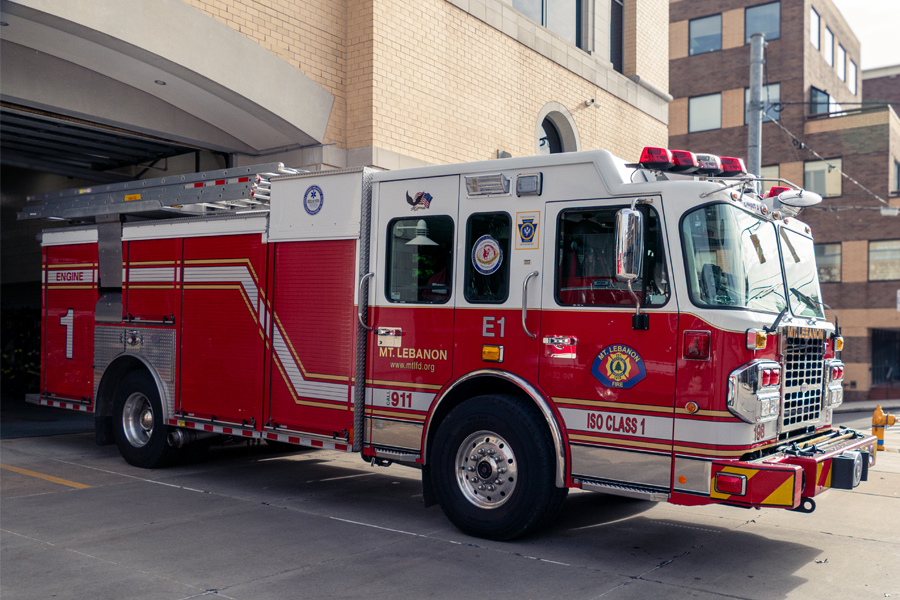
MRTSA plays an important role, including helping restock supplies after calls. “They’re super helpful and beneficial to making this successful,” said Quatchak.
The relationship between the two organizations has evolved along with the department’s EMS responsibilities. Firefighters were quick to note that the department’s growing role was not an attempt to take EMS jobs.
“We were just trying to help. They cover Dormont, Whitehall, Castle Shannon, Green Tree. It’s a huge area,” said Mt. Lebanon Fire Chief Kurt Christofel. “[Former MLFD] Chief [Nick] Sohyda explained it well to me. If it were your family member choking in Mt. Lebanon and the ambulance was coming from Presby, you’d want somebody from here coming to help.”
Cardiac arrests are another prime example where every minute counts. Even when MRTSA and another ambulance service are already responding, firefighters said it can take six, eight or even 10 people to manage a cardiac arrest effectively.
David Terkel, Chief of Operations at MRTSA, said collaboration with the fire department is extremely helpful.
“First off, it enables us to prioritize calls a little differently than we used to. For example, if I know I have a licensed QRS agency sending two-plus people to a call, I can send a unit from Shadyside Hospital or a much further away distance. Whereas if there wasn’t that [QRS] agency that was able to respond first, we’d probably have to give that call away to mutual aid and neighboring EMS service,” Terkel explained.
“So that’s a huge deal for us to be able to reduce the number of times we call outside agencies in for help, by being able to know that there’s someone there providing initial care, and they can provide us a little more time on our response model.”
Firefighters say they now encounter death and critical injuries far more frequently than they did a decade ago. Christofel recalled a fire shift with 12 cardiac arrests and none of the patients survived.
The increased exposure to medical emergencies means more training and a broader range of responsibilities. The department regularly adds new medications to their supplies, introducing Narcan, which reverses narcotic overdoses, and, more recently, epinephrine and blood glucose testing kits.
“It’s more tools in the toolbox,” Quatchak said.
Despite the added demands and stressors, firefighters say the medical side of the job brings variety and provides another way to serve residents.
“Personally, I like that we provide that service,” Quatchak said. “It adds variety.”
The EMT responsibilities are expected to continue growing. MRTSA gets busier every year, Quatchak said, and the population is aging, creating increasing demand.
This year, the department started a volunteer EMS pilot program designed to give EMT-certified volunteers more opportunities to gain experience without taking a fire engine out of service. So far, about eight volunteers have signed up and are completing field training, after which they will be able to staff an SUV independently. When a fire call comes in, they can still ride the engine. Otherwise, they can respond to EMS calls in the squad vehicle.
For volunteers who have earned their EMT certification but do not work elsewhere in EMS, the program provides a chance to gain more patient contacts and sharpen skills. It also allows fire engines to remain available for other emergencies.
The goal, Christofel said, is not to replace MRTSA but to strengthen the emergency response available to the community.
“Partnering with MRTSA has strengthened emergency medical response in Mt. Lebanon,” Christofel said. “We truly work as one team, and we all care about the health and well-being of Mt. Lebanon residents.”
Terkel agreed. “I wouldn’t trade having that department for anything. They’re truly an asset to how we operate.”
 Full Story