



Preserving film history
Chad Hunter’s fascination with movies runs in his family.
“My grandfather was a film projectionist in World War II on an aircraft carrier,” Hunter said. “He would show 35-millimeter nitrate films. He would get into port and trade prints with other ships’ projectionists.”
Hunter, of Orchard Drive, is also passionate about showing films and preserving all types of media. In April, he became the new archive director of the Appalachian Film Workshop. Founded in 1969 in Whitesburg, Kentucky, it is known as Appalshop.
Hunter, 54, oversees the nation’s largest collection of Appalachian media, which includes art, artifacts, audio, feature films, glass plate negatives, posters, photographs, printed material and video.
The Appalshop archive documents art, crafts, coal mining, daily life, farming, labor disputes, music, politics, religion, strip mining and storytelling in Appalachia. The 13-state region includes Pennsylvania, Ohio, Maryland, New York and West Virginia.
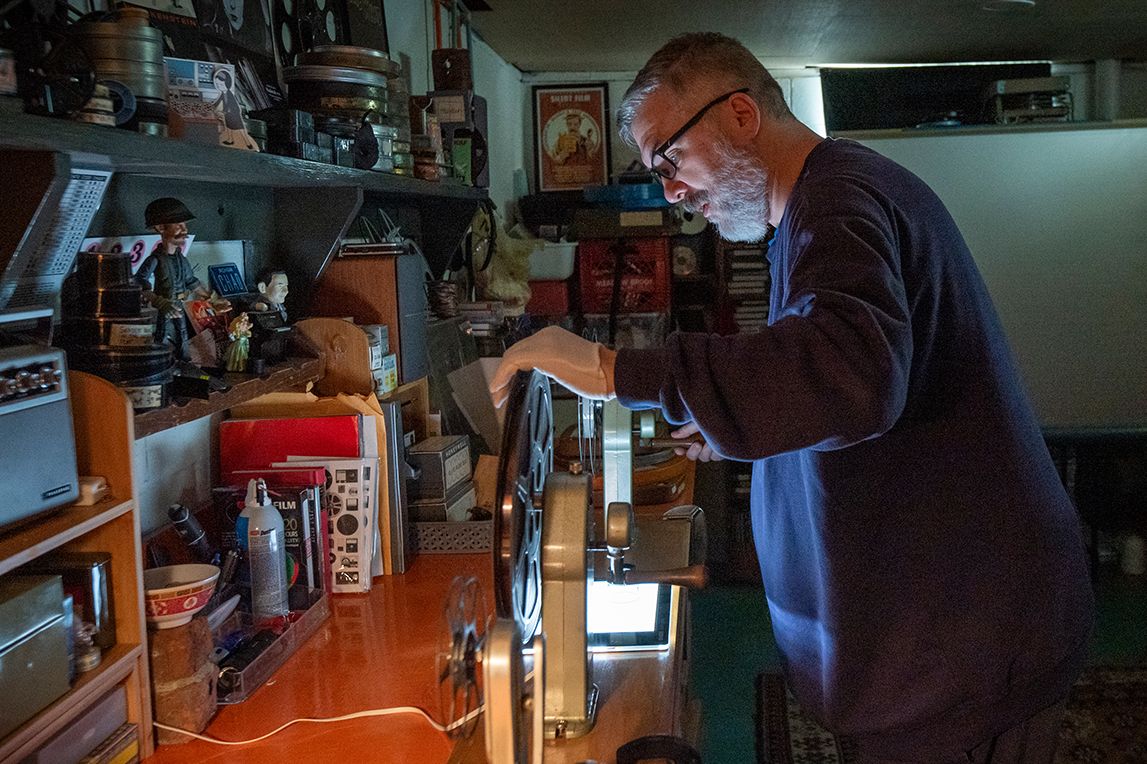
In his home’s basement, Hunter works daily at a film inspection and projection space, examining the condition and quality of films from the archive.
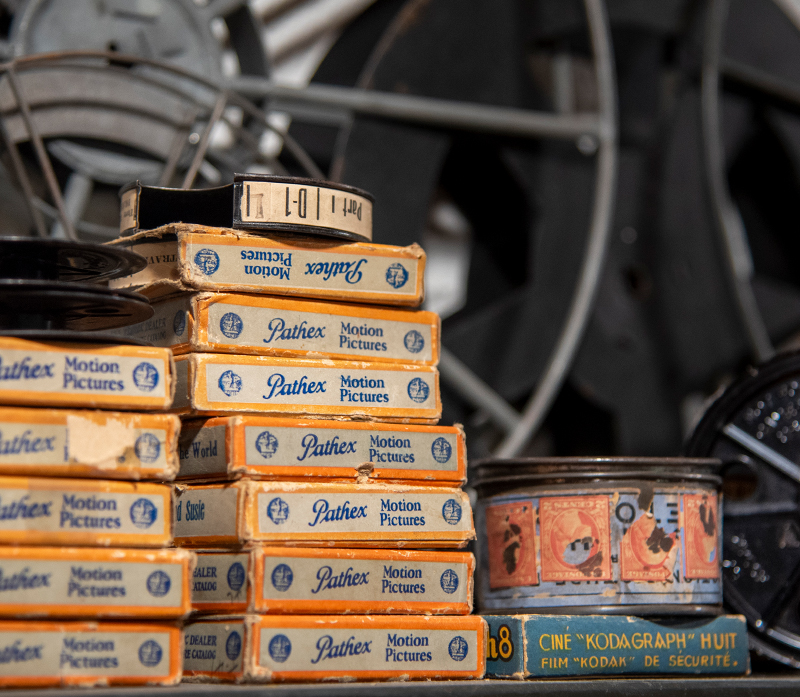
“Is it shrunken? Does it have vinegar syndrome, perforation damage? Does it have mold?” Hunter said, adding that “We have to shift to do this work ourselves,” because 85 percent of the Appalshop archive funding has come from federal grants.
His interest in film dates to his boyhood in Haslett, a town outside of East Lansing, Michigan.
“I remember sitting in a gymnasium in my elementary school, watching a 3-D, 16-millimeter print of The Creature From the Black Lagoon. That moved me,” he recalled.
Later, while attending the University of Michigan, Hunter developed a fondness for silent movies. Between classes, he worked at a video rental shop and saw silent films at the historic Michigan Theater in Ann Arbor. The theater’s pipe organ played while he watched Charlie Chaplin’s The Circus, a romantic comedy. A screening of Joan of Arc featured live choral accompaniment.
Those experiences prompted Hunter to start Pittsburgh’s Silent Film Society and Festival. This year, the festival features silent films from 1925 and runs from September 27 through October 5. Some screenings will offer live musical accompaniment.

Hunter began his career at the George Eastman Museum in Rochester, New York, one of the country’s five biggest film archives. (The other four are the Library of Congress in Washington, D.C., the Museum of Modern Art in New York City, the University of California at Los Angeles and the Margaret Herrick Library at the Academy of Motion Pictures in Beverly Hills, California.)
The Appalshop archive was started in 2002. Hunter began working with it as a co-founding archivist in 2005. A $225,000 grant from the National Endowment for the Humanities allowed the organization to launch its preservation program.
In July, 2022, the Kentucky River flooded, damaging Appalshop’s collections. Hunter drove to Whitesburg, volunteering to move film cans and boxes to safety. Appalshop hired him as a consultant to salvage the collection, some of which was stored temporarily in two donated refrigerator trucks.
Hunter and his colleagues scrambled to send parts of the collection to preservation labs and wrote grant applications. A large grant from the Institute of Museum & Library Services allowed them to send color, 16-millimeter films to Colorlab, a film preservation company in Rockville, Maryland.
A $225,000 grant from the National Endowment for the Humanities was supposed to save three important photo collections. From 1935 to 1955, William R. “Picture Man” Mullins recorded life in Baltimore, eastern Kentucky and southwestern Virginia. Those 3,500 negatives have been preserved.
When the grant was rescinded in April, the project stalled. Images captured by Robert Gumpert and Jeff Whetstone, who recorded life in eastern Kentucky during the 1970s, remain in freezers in Kentucky and are at high risk of deteriorating.
“After the flood, we were advised by the Northeast Document Conservation Center in Connecticut to quickly freeze the negatives. So we purchased some commercial chest freezers and they had to wait there for a year,” Hunter said.
The flood forced Appalshop to move out of its Royal Crown Cola bottling plant office in Whitesburg to Jenkins, a town 15 miles to the east. Its new home is the second floor of a building that once housed coal company offices.
“We are setting up a new film and media preservation laboratory on the second floor. We have a 4K 16-millimeter scanner so that you can make copies of 16-millimeter film,” Hunter said.
After the flood, Hunter and his colleagues looked for temporary storage space.
“At first,” Hunter recalled, “the response was, ‘I am sorry.’ Everyone was worried about introducing a dirty, flood-damaged collection into their clean vaults because they were afraid of contaminating their own collections.”
That’s when Appalshop found a home for its audio and video collections at Iron Mountain, an underground limestone mine north of Pittsburgh in Boyers, Butler County. Hunter must find a way to save that media. Cold temperature and low humidity in the mine delays the deterioration of those collections.
“It buys us some time,” Hunter said.
Neither the loss of a grant nor the flood has deterred the leaders of Appalshop from planning for the future. In 2023, the nonprofit bought a 100-year-old hospital in Jenkins and plans to raise $3 million to renovate the building, which has 11,500 square feet of space and sits on five acres. The brick and stone structure sits on a hill, well outside any new flood plains, Hunter said.
“There’s a morgue there that would make a perfect media vault. It’s a wonderful, creepy building,” Hunter said, adding that it will be a place where people can bring in their own media and learn how to preserve it. Plans include space for an art gallery and a studio for collecting oral histories or podcasting.
Raising money from foundations, corporations and people is Hunter’s top priority. His new job, Hunter said, is “wonderful timing. I get to use everything I’ve learned, all the skills I have, all the connections I’ve made. It’s a perfect fit for me.”
Tiffany Sturdivant, executive director of Appalshop, said hiring Hunter, who was chosen from 19 candidates, puts the organization “two steps ahead of the game” because of his institutional knowledge and professional contacts.
When people return to Appalachia to clean out a family home, Sturdivant said, “they find family heirlooms. They want to bring them to us. They want to know how to digitize things and save photos.”
Appalshop, Sturdivant said, “reminds people about the ingenuity and the innovativeness of Appalachia. Making something out of nothing is not new to that region.”

 Full Story