



St. Clair Checkup: From Collapse to Comeback
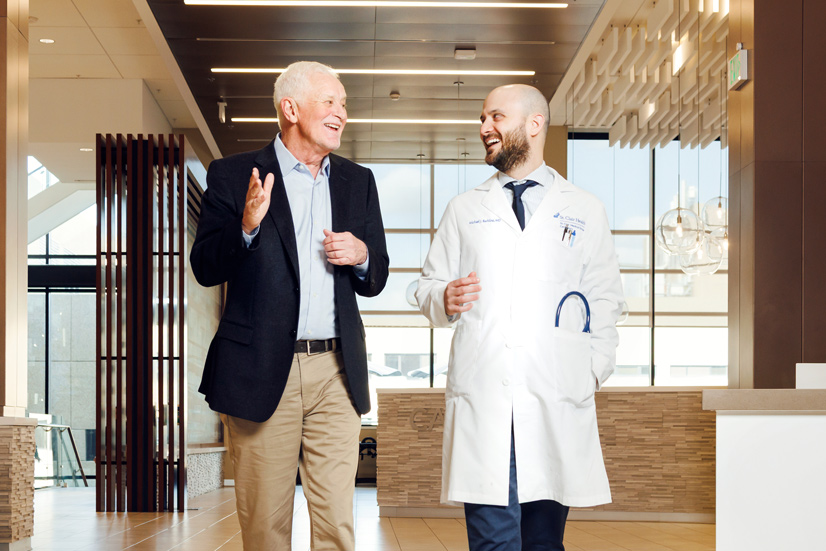 Tommy Shea had always considered himself a healthy guy. The Greentree resident exercised regularly, lifted weights, swam in the summers, and practiced tai chi and jiu-jitsu. Still, healthy individuals like Tommy can develop a pulmonary embolism without warning—especially after illness, surgery, or long periods of inactivity.
When he was feeling unusually fatigued in December 2024, Tommy chalked it up to a lingering case of COVID-19. “I figured it would pass. I was laying low, resting, waiting to bounce back,” he recalled. “But I wasn’t getting better.”
Tommy continued, “I first felt it the week before Christmas. Fifteen minutes of tremendous pressure on my chest, and then it passed. I thought it was just a weird side effect of the virus. Little did I know, that was the first pulmonary embolism.”
When it happened again on New Year’s Day in January 2025, Tommy collapsed. “I suddenly felt like there was an elephant sitting on my chest. It hit me out of nowhere,” he said. “I got out of bed and collapsed right back down. I told my wife, ‘I think I’m dying.’ I could barely talk or walk.”
An ambulance rushed him to St. Clair Hospital, where imaging revealed a massive bilateral pulmonary embolism—a life-threatening blood clot that had obstructed blood flow to his lungs and put intense pressure on his heart. Interventional cardiologist Michael J. Bashline, MD, was on call and part of the Pulmonary Embolism Response Team (PERT) that immediately took action.
“Though Tommy was incredibly fit and healthy, with no known medical issues, I knew we couldn’t wait to treat him,” recalled Dr. Bashline. “He didn’t look well, as his heart was under enormous strain and his oxygen needs were high.”
Dr. Bashline explained the treatment options—take a blood thinner to allow the clot to dissolve slowly or undergo a pulmonary embolectomy, a catheter-based procedure to physically remove the clot.
“I looked at Dr. Bashline and asked, ‘Have you done this before?’” Tommy said. “He responded, ‘Many times. This is what I do.’ Dr. Bashline was calm and confident, which gave me confidence, too. I felt totally safe in his hands.”
Tommy added, “I can’t say enough about the speed at which the process occurred and the coordination of all the different entities.”
Dr. Bashline completed a right heart catheterization and then used a large suction catheter inserted through Tommy’s groin to remove the clot. He said, “We extracted a significant amount of clot, especially from the right lung. The moment we did, his heart rate normalized and he was breathing comfortably again.”
In addition to prescribing a blood thinner to dissolve a remaining chronic clot in Tommy’s left lung, Dr. Bashline completed a second procedure to remove an extensive blood clot in his left leg after post-operative testing revealed a deep vein thrombosis (DVT).
“Dr. Bashline wasn’t taking any chances,” Tommy said. “You can be fine one day and nearly dead the next. But if you’re lucky, you’ve got a place like St. Clair Health nearby and someone like Dr. Bashline ready to save your life.”
When asked what Tommy would say to Dr. Bashline and the other team members who saved him, he exclaimed, “I owe everything to the team at St. Clair Health. They didn’t just treat me—they brought me back. I’m feeling 100 percent again.”
If the problem is your heart, the answer is St. Clair Health. Where we’ve assembled some of the country’s best heart specialists and created one of the most comprehensive heart programs. To schedule an appointment with Dr. Bashline or another St. Clair Health heart expert, call 412.942.8990.

 Full Story